The Darwin Incident (2026), produced by Bellnox Films

Reviewed by Kin-Long Tong

Charlie can leap over fences, tear through steel, and outrun most humans. Yet the most unsettling thing about him is not his body, but his voice. He speaks.

Based on the award-winning manga by Shun Umezawa, The Darwin Incident (ダーウィン事変) follows Charlie, a humanzee –a human-chimpanzee hybrid born after the rescue of a pregnant chimpanzee from a research facility. Set in contemporary Missouri, the 13-part anime follows Charlie as he navigates high school alongside his friend Lucy while becoming the unwilling focal point of a widening conflict between scientists, politicians, the media, and the radical Animal Liberation Alliance (ALA), who seek to turn him into the face of their movement.

Initially, the premise recalls that of Planet of the Apes, which also uses intelligent non-human animals to explore questions of power and identity. Yet The Darwin Incident distinguishes itself by placing those questions within a world shaped by social media, political polarisation, and competing claims to moral authority.

Many discussions of the series focus on its treatment of animal rights, veganism, environmental activism, or contemporary American politics. Whilst these themes are certainly present, what interested me most was neither the series’ politics or speculative premise, but a brief exchange between Charlie and Lucy.

“What’s it like to be a humanzee?” Lucy asks.

“I wonder about that too,” Charlie replies. “What’s it like to be a human?”

The question quietly overturns the assumptions that structure the series. Charlie is often treated as the one who requires explanation: a biological anomaly, a political symbol, an object of scientific curiosity. Yet his response redirects that curiosity back toward humanity itself. Rather than presenting Charlie as a problem to be solved, The Darwin Incident invites audiences to examine the categories through which we understand ourselves and others.

The series is careful to avoid presenting speech as a simple solution. Charlie speaks the same language as everyone around him, but communication remains surprisingly fragile as the assumptions beneath the words’ meaning are misaligned. This becomes especially apparent in the show’s recurring debates about animal ethics. When a bully presents Charlie, who is vegan, with a hypothetical scenario involving a disease-carrying mouse, the question seems designed to expose the contradictions of animal-rights philosophy. Charlie calmly agrees that he would kill the mouse to prevent harm. But when he adds that he would apply the same logic to a disease-carrying human, the conversation suddenly shifts.

Nothing has been mistranslated at the level of language: characters use the same words and participate in the same debate. The misunderstanding lies elsewhere – in the different moral worlds each speaker inhabits. Yet the questions raised within the series do not remain confined to its characters. Is it a critique of animal exploitation? A commentary on contemporary activism? A philosophical thought experiment about human exceptionalism? The Darwin Incident invites all these readings without allowing any single one to settle comfortably in place.

Perhaps it is fitting, then, that the series itself has become a site of similar misunderstandings. One of its most divisive aspects is its portrayal of contemporary American society. Produced by the Japanese animation studio Bellnox Films, the irony is not lost on me. Western audiences have long been accustomed to seeing Asian societies filtered through foreign eyes; in The Darwin Incident, it is America that becomes the object of observation.

Set in Missouri, the series has been criticised for its exaggerated depictions of school life, from vegan student protests that quickly spiral into culture-war clashes to theatrical scenes of cafeteria bullying. I find these criticisms revealing, not because they are necessarily misplaced, but because they illuminate the series’ ambitions. The Darwin Incident is less interested in faithfully reproducing everyday America than in constructing a stage where competing ethical positions collide. Its characters often speak less like ordinary teenagers than participants in a philosophical dialogue – a stylisation that can feel awkward yet ultimately serves the questions the series wants to ask.

Rather than resolving these tensions, the series eventually lets Charlie articulate them for himself. In the confrontation marking the plot climax – the ALA kidnap Lucy in a bid to to radicalise Charlie and make him their leader – he quietly remarks:

“Human language is a highly versatile software. But even if another species could suddenly speak English, there’s no guarantee you could actually communicate.”

Charlie’s observation reframes all that has come before. The obstacle has never been language itself, but the assumptions attached to it. Charlie speaks fluently and argues carefully, yet his words are continually absorbed into narratives that precede him. To scientists he is an experiment; to activists, a revolution; to others, a threat. Asked what he actually wants, however, his answer is strikingly modest:

“I want to go to school with Lucy.”

At a moment when everyone else is speaking in the language of species, ideology, and political destiny, Charlie speaks in the language of ordinary life. Perhaps this is his irreducibility. It lies not in his extraordinary biology, but in his refusal to become the symbol everyone else needs him to be.

That is also the series’ most unsettling question: what happens when someone can be heard perfectly well, yet still resists translation?

The Darwin Incident is available on a number of streaming platforms in multiple languages, including Amazon Prime Video and Apple TV.

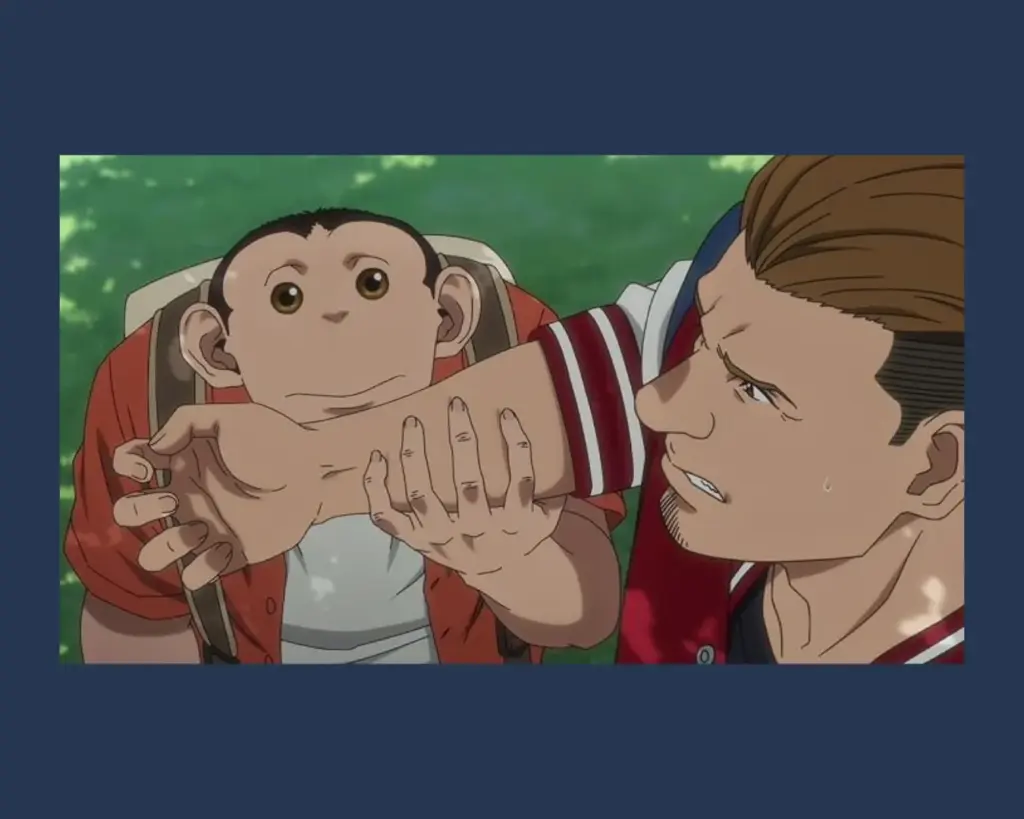
Still from Episode 6, ‘Direct Action’

Share:

Related Articles