
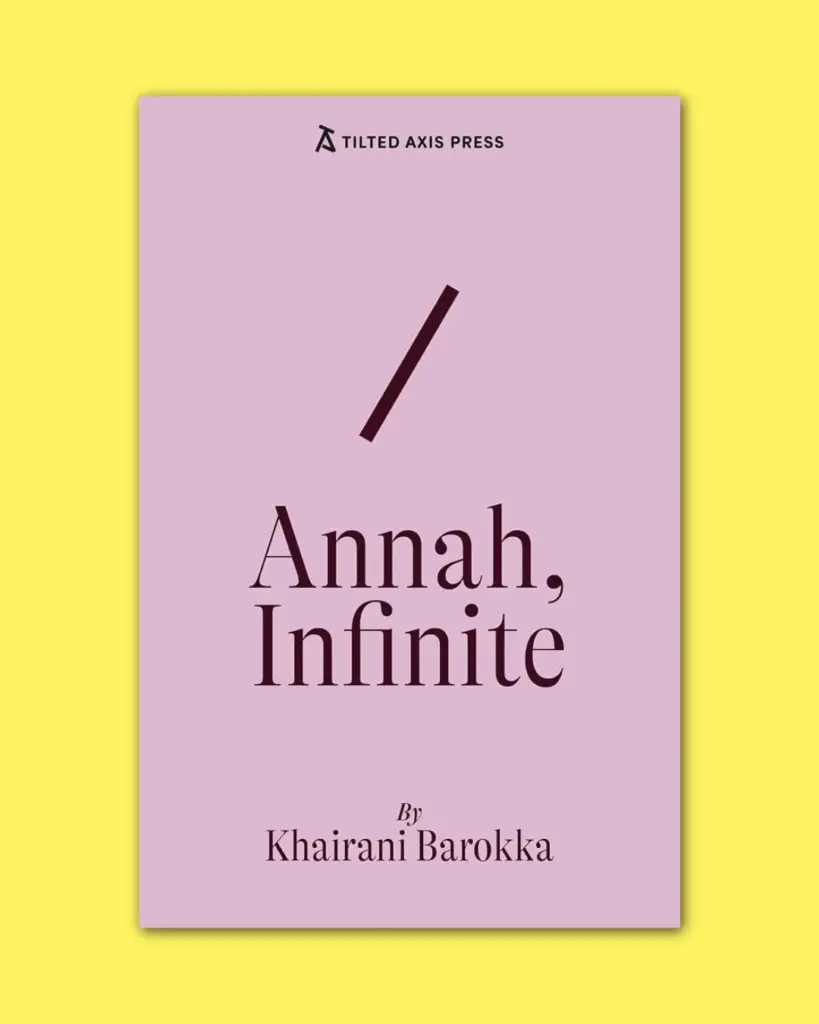
Annah, Infinite by Khairani Barokka
(Tilted Axis Press, 2025), 325 pages
Reviewed by Fairuza Hanun
I first heard about the portrait Annah La Janvanaise. Aita tamari vahine Judith te parari by Paul Gauguin in an article written by Khairani Barokka, published in the online magazine The White Review. The article was titled ‘Selected Annahs’, as if out of hundreds of thousands of versions of Annah, only a few had been recovered—this notion seems to have been the catalyst for this book.
Annah, Infinite reveals the hidden histories and memories embedded in the painting. Over time, these memories—like deposits of fine dust, or traces of skin cells left behind from its original creation—have been obscured by conservation efforts, which often remove evidence that art institutions might prefer to hide.
Among these hidden traces, now revealed, are the lingering impacts of colonialism. But the book also uncovers other deep and difficult subjects connected to the painting—including abuse, violence, and child exploitation—showing how these issues persist through multiple versions and reproductions of the artwork.
Many of the artists interviewed by the author who have engaged with the painting Annah la Javanaise often assume that Annah was Tahitian or Javanese. Others suggest she came from other places colonised by Europeans. What matters to these observers is the way Annah functions as a symbol of Gauguin’s closeness to and sexualised engagement with ‘primitivism.’
But reducing Annah’s life to this symbol simplifies her existence and mirrors the colonial impulse to erase complex lives. Gauguin and other colonisers renamed, extracted, and reframed individuals like Annah, claiming to transform them into objects of artistic or cultural value. Observers’ assumptions that Annah was female, able-bodied, consented to sexual intimacy with Gauguin (as implied in the painting) and was Javanese, are narrow interpretations, and deliberate distortions by the painter. The painting obscures the reality of time, situation, socio-political context, and bodily experience. Misinterpretations are compounded when language and framing fail to preserve nuance, conflating populations, identities, and histories across multiple European colonies.
In a world dominated by visual culture, acts of translation extend beyond words into images and symbols. Every artistic choice in a painting carries meaning, and what is omitted—in visual cues, captions, or descriptions—also contributes to the erasure and diminishment of certain ‘bodyminds’.
How did Annah receive a Western-sounding name? Barokka suggests that it may have resulted from misunderstanding, or a kind of neglect, when Annah was brought to the opera singer Nina Pack (who later gave Annah to Gauguin). Someone may have asked: “Who are they?” to which someone else replied “Anak”, meaning “child”. Over time, Anak became Annah.
Gauguin’s portrayal of Annah in an adult-like form, despite them being only 13 years old (the same age as my students!), suggests a highly likely site of sexual violence, especially considering Gauguin’s documented abuse of his wife and son. What about the other name in the painting’s title, Judith? “Aita tamari vahine Judith te parari” means “The child Judith has not been breached”, acknowledging the childness of Judith, and the immorality of sexual violence against a white child. In contrast, Annah—brown, and from a European colony—is dehumanised. In the colonial imagination, native children were assumed promiscuous.
Among the many possible versions of Annah’s life, aside from kidnapping, is that in which they may have been found in a Montmartre brothel, suggesting they had been a sex worker. Barokka argues that transferring her from sex work, perceived at the time as a pathology, into a male artist’s circle was framed as a ‘rescue’, a performance that validated Gauguin’s virility. This narrative is further complicated by evidence that Annah was likely disabled.
“Misinterpretations are compounded when language and framing fail to preserve nuance, conflating populations, identities,
and histories across multiple European colonies.”
For the French government, the ‘pathology’ of disability was largely ignored, whereas the perceived promiscuity of brown women and sex work was considered more urgent. Annah’s potential disability, combined with sexual violence, trauma, and lack of access to care (including gender-affirming care), along with colonial assumptions about her ‘native womanhood’ ensured that her suffering was ignored, and her vulnerability amplified.
Annah, Infinite is a radical, defiant reimagining of the many possible lives a child might inhabit within a painting, whilst freeing its soul from the violent framing of colonial knowledge. It reinterprets history, offering alternative narratives across different temporal perspectives, and revises the translation of visual images into stories.
Annah, Infinite
by Khairani Barokka
Tilted Axis Press, 2025
325 pages
The book envisions these interpretations as existing within an infinite cosmology. It reclaims the spirits of all people who have been, and continue to be, colonised. Within each of us, a fragment of Annah lives on, reincarnating in the portraits of women, queer people, Indigenous peoples, and people of colour, those both oppressed and joyful.