An interview with Abeera Kamran and Zeerak Ahmed, by Sophia Smith Galer
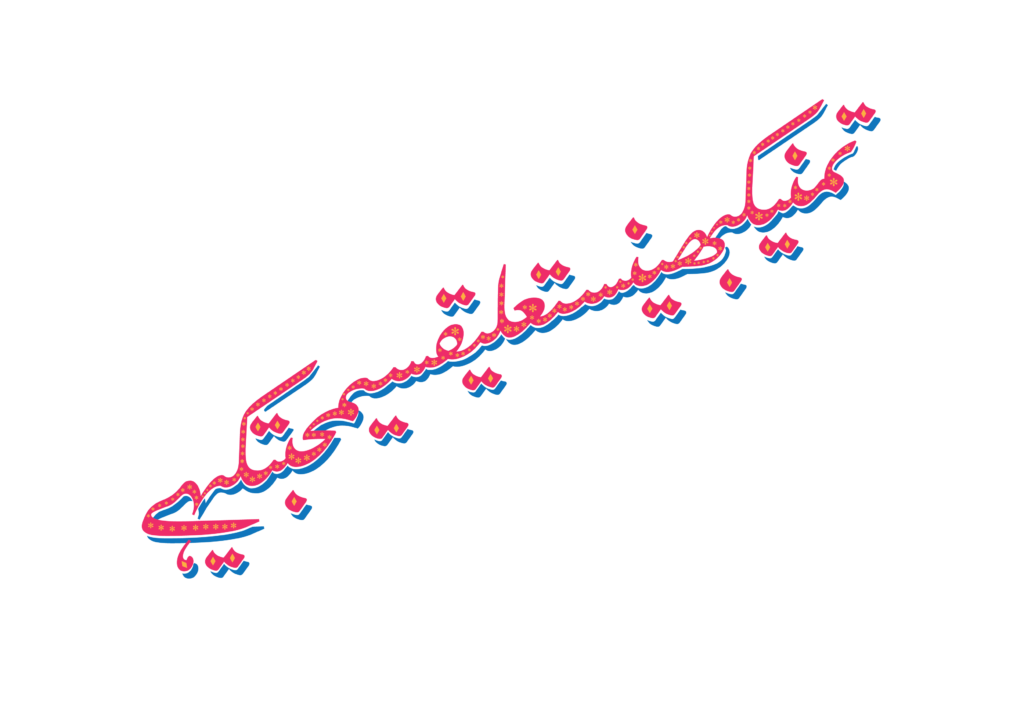
Ten years ago, Khawar Latif Khan and his sister had a problem. At almost the exact same time I would have been writing my own university essays in Arabic on Microsoft Word without a problem, the same software gave Khawar’s sister no such option for her own mother tongue, Urdu. Writing a 200-page dissertation in any language or script is hard enough. But Khawar and her sister had to re-type out all 200 pages into InPage, the Pakistani software that was the only way to type out Urdu in its script, known as Nastaliq.
Then, they converted the text into Unicode. After that, they installed Urdu font packages for Microsoft Word. Only then were they able to bring the dissertation into Microsoft Word, reformat it, and present it in a way that could be handed in. Years later, he wrote that “the entire process could have been much simpler if Urdu had even half the amount of technical support as English or other Latin languages.”
People might call Latin a dead language, but they forget that part of it remains very much alive: its script. There are over 7,000 living languages today, and up to half of them use an alphabet crafted by the ancient Romans. The Latin alphabet, by far, is the most active orthography in the world.
Online, it can almost feel like Latin script was designed for the internet, given the ease with which you can type in a web address, or write a line of code, as if the Ancient Romans predicted the computer. Of course, in reality, it’s the other way around: it has everything to do with the internet being designed for Latin script.
In the 1960s, when engineers built the first computers we would (vaguely) recognise as such today, they onboarded the QWERTY keyboard that had been used on commercial typewriters for almost a century. The typewriter had already long made the QWERTY keyboard the industry standard for English-language keyboards; now, with the United States taking the lead in the computer revolution, this would become the internet’s standard too, with its 26 letters, its numbers, and its punctuation.
From a design standpoint, the Latin alphabet as modelled by English offered simplicity. The letters are all separated, it’s blocky, and it’s written in a straight line. But it also had the advantage of being the writing system of all the Western macrolanguages that had been expanded during the age of empire. As a result, the first computers suited a good 70 per cent of the global population (albeit with minor variations – e.g. a French computer keyboard’s top line reads AZERTY). The rest of the world looked on, with their myriad scripts, waiting to be digitised. And, incredibly, for Urdu – a language with 230 million speakers today – that wait is ongoing.