The deadly, destructive flood in Nepal must prompt the country to look inwards at its own model of development, argues a Nepali writer
In an evocative, incisive piece written in the aftermath of the catastrophic flood in northern Nepal last month, writer, journalist, and farmer Narayan Wagle reflects on the country’s infrastructure-first development model. In its pursuit of a particular model of ‘development’, Wagle argues that Nepal has sacrificed its own indigenous way of life on the altar of a development model imported from abroad that sees the rivers and hills as sites to be extracted and not as markers of heritage and culture.
Wagle begins by referencing the popular song Bheda ko Oon Jasto (Like sheep’s wool) by the Nepali band Nepathya. The song grew out of a folk tune Wagle first heard in the hills of the Langtang Valley, the same region devastated by the flood. Over 20 years ago, in 2003, Wagle, accompanied by members of Nepathya, went on a walking tour of Langtang, searching for the roots of that tune. That journey became an award-winning documentary titled after the song.
Wagle contrasts the central metaphor of the song (a tune floating through the air like a cloud made out of sheep’s wool) with the devastation of the flood (“no soft, white wisps of cloud but a hazy, muddy torrent of boulders.”) The path the “maddened” Bhotekoshi/Trishuli river took in its trail of destruction was the same route along which residents of the capital Kathmandu had long dreamed of a railway line coming down from China, bringing development and prosperity with it. He calls this a “delusion” that took hold of the Nepali consciousness, where rivers and streams were seen in utilitarian terms as upstream “sources of electricity” and downstream “sources of stone and sand to be exploited.”
“We do not have the luxury of mourning in silence the loss of so many families, friends, relatives, loved ones and fellow citizens,” writes Wagle. “We need the right mentality and strength to emerge from this grief, so that we have the courage to review our ways of thinking, and recognize the warning that has been given.”
For too long, Wagle laments, development has been defined by people who do not live in the areas most affected by its consequences. The pursuit of development transformed the Nepali way of life by first transforming what Nepalis valued. Instead of recognizing the “skills, traditions, talent, hard work, labour, customs and culture” of Langtang, the state-led model of development convinced us that those living in the hills were “backward fools.” They were encouraged to abandon their highland ways and descend to the lowlands where roads and conveniences were plentiful. This narrative drained the yak and sheep herders of their self-respect and denied them recognition as an “outstanding example of heritage farming, culture and nature”. Nepal’s model of development turned citizens into “consumers,” writes Wagle. “Our cultural and everyday relationship with nature became transactional.”
Wagle concludes his essay by asking why the state never asked the people of Langtang what kind of development they wanted, positing: “Does the remedy for the wound inflicted by this catastrophe, where a flood came down from the very sky, lie within ourselves?”

Summarised by freelance journalist Pranaya Rana.
| Pranaya’s take: Much of the reporting on the Nepal flood has focused on the number of lives lost, the extent of the damage, and the disaster’s links to climate change, particularly in mainstream English media. The Nepal government is also pushing the narrative that Nepal is suffering the consequences of someone else’s actions, and that developed countries – particularly China, the United States, and India, the top three emitters of greenhouse gases – bear moral responsibility for the flood. Wagle’s article is among the few pieces of commentary that looks inward, examining how Nepal’s own actions might have exacerbated the cost of the disaster. Wagle points out how rivers like the Bhotekoshi are used to generate hydropower even as their riverbeds are mined for sand and pebbles. Even though indigenous knowledge warns against settling by the riverside, trade and commerce have lured hill dwellers from the lek, the highlands, to the besi, the river basin. Nepal can hold polluters morally responsible, but that will not make Nepal more resilient to the consequences of climate change. The state will need to do the hard work itself by looking inwards and reconsidering its own practices. |
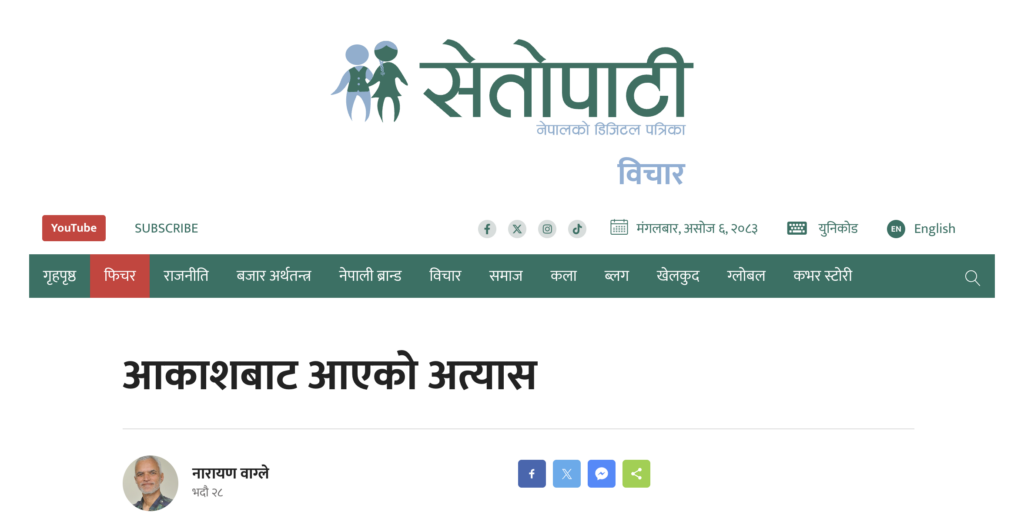
The original article ‘आकाशबाट आएको अत्यास‘ was published in Nepali by Narayan Wagle for Setopati on September 13, 2026.
Setopati is an independent Nepali outlet started by journalists ‘exhausted by the vagaries of corporate media stymieing the journalistic pursuit’.