
Translator’s Karachi-based contributing editor and journalist Sanam Maher, looks at BBC Urdu’s coverage of recent flooding in Pakistan.
In Read Between the Lines we commission a journalist or commentator from beyond the Anglosphere to interpret a recent article they have found interesting or important from their local media landscape: decoding the article’s meaning in the broader political, cultural and social context in which it was written, helping us understand how it would be read locally and giving us insight into what is making headlines (and why).
How is an article being received? What’s the backstory? What is being really said – and what is left unsaid?
Sometimes, a deeper understanding an article isn’t a case of translating or summarising it. Sometimes, we need to read between the lines.
In our first Read Between the Lines online, our Karachi-based contributing editor and journalist Sanam Maher, looks at BBC Urdu’s coverage of recent flooding in Pakistan, and the emphasis on not just the physical but the psychological devastation left in its wake.


After the August floods in Khyber Pakhtunkhwa
With every monsoon season in Pakistan since 2022 comes a grim new measure of the devastation: in 2022, when Sindh province, where I live, received eight times its average rainfall, United Nations Secretary General Antonio Guterres described the rains as “monsoon on steroids” that left 1,000 dead; in 2023, “record-breaking” rainfall turned roads to rivers in Lahore, Pakistan’s second-largest city; in last year’s “unprecedented deluge”, we received 51 percent more rainfall than the average. Every year, we become more vulnerable to the effects of climate change, and this year’s monsoon has brought on “the worst floods on record” in the country’s history. According to the World Bank, Pakistan still needs $16 billion to recover from the 2022 floods. We’re playing catch-up to a goal that feels increasingly out of our reach, and in the meantime, as a report in BBC Urdu this August showed, those who have survived haven’t just lost their livelihoods, homes and family members – they’re struggling with the trauma of this annual battering.
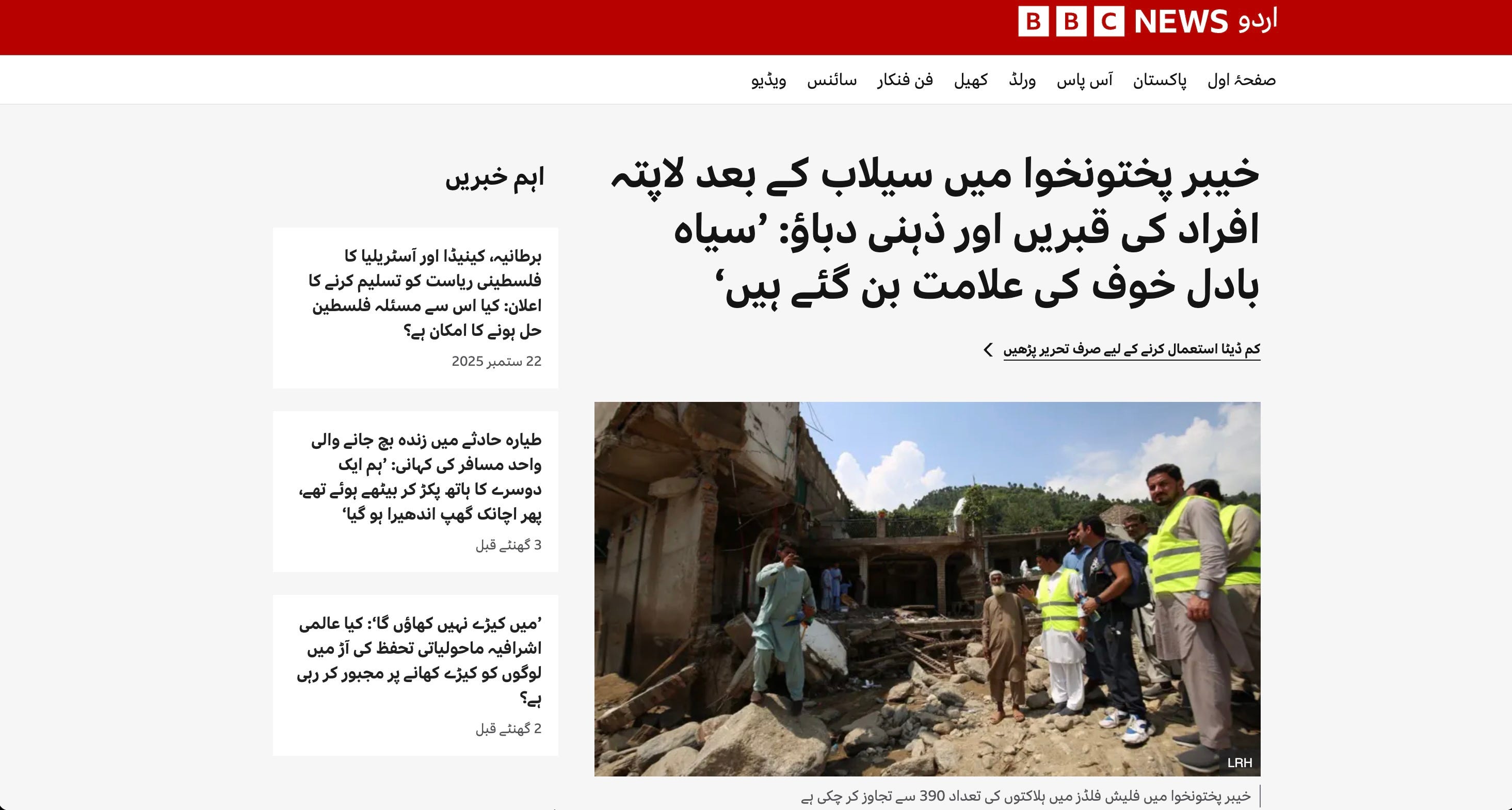
In the piece, “Graves of missing persons and mental stress after floods in Khyber Pakhtunkhwa: ‘Dark clouds and heavy rain have now become a symbol of fear in this village’”, reporters Azizullah Khan and Bilal Ahmed write from Buner district, in the northern province of Khyber Pakhtunkhwa, where flash floods on 15 August 2025 killed 400. They follow psychiatrist Dr Muhammad Israr and his team as they meet survivors from different villages in the district. Dr Israr surmises that “When the clouds rolled in and the rain started in front of us in the village of Bishonai, people were panicking. We have never seen such a situation in our lives. People seem to suffer from an undiagnosed psychological problem.”
Buner suffered the highest loss of life, while floods in other districts such as Swat, Bajaur, Shangla, Battagram and Swabi have also caused extensive damage to property, livestock and agriculture. According to the Provincial Disaster Management Agency (PDMA), the death toll in the flash floods has exceeded 390.
Dr Muhammad Israr, assistant professor of psychiatry at Lady Reading Hospital Peshawar, told the BBC that the people in these areas have become psychologically fragile. “They don’t know what they are doing and what is happening to them.” One patient, he said, is around 40 to 45 years old. Dr Israr said that Hamid (name changed) lost 18 people in his family and he was the only survivor. Some members of the family are still missing, and a search is on for them. Hamid was sitting in a mosque, and people came to him to express their sorrow and condolences for his loss, but he was completely lost in thought.
Dr Israr said that other families in the area are desperately trying to find missing family members or hoping “at least their bodies will be found”. Graves have already been dug for some missing people in this area.
Dr Israr gives the example of a patient who has now lost both his legs due to injuries sustained during the floods. “His entire family was swept away,” Dr Israr says. “Treatment is ongoing, but the patient is unable to communicate. They cannot understand what is happening.” They just stare at people, and if they try to talk to someone, ‘‘they start crying”.
Dr Israr explains how anxiety is manifesting itself among the patients he has seen:
There was such a sense of fear among the people, that when a corner of one person’s umbrella hit another’s shoulder, that person started trembling. He said, “You almost killed me. I thought something terrible happened.”
At another point in the article, the authors tell the harrowing story of Zeb, who lived and worked in Saudi Arabia. He had a return ticket booked for 12 August, but postponed his return as there was a mukha (archery) match to be held in his village.
“If only he hadn’t delayed his ticket to return to Saudi Arabia because of the match, he would be alive today. Maybe death was holding him back.” Muhammad Idrees was crying bitterly while he said this. Thirty-seven people were killed in a cloudburst in the Dalori Bala area of Swabi, and one of them was Idrees’s childhood friend Anwar Zeb. Zeb, his wife, children, mother, and sister-in-law, along with 14 other family members were killed in the floods. Only two members of the family have survived.
The article relates that, the night before his death, Zeb had lost the archery match by one point and had spoken about the next one, expressing the hope that it would be held by the riverbank. He was found with the bodies of his children in his arms.
I feel like I read the same story every year about the trauma that survivors endure, and with every monsoon, I am reminded that we do not have the resources to help them. In 2022, I travelled to a village in Balochistan where an international aid agency had partnered with local mental health professionals to offer counselling to flood survivors. The counsellors shepherded a group of women into a one-room home. The women sat on the floor and looked up at the counsellors – a man and a woman – who asked them to share what was on their mind. Some of the women stared listlessly at the walls or fidgeted, preoccupied. The ones who did share talked about anxiety about the coming days and how they would start afresh when they had lost everything. The counsellors prescribed being grateful to be alive, and to give thanks to Allah that their lives had been spared, when others had not. Anxiety could be kept at bay, they suggested, by remembering that Allah provides for us, and we must never lose hope or be ungrateful, for we always have blessings that we can count.
Separately, when I spoke to these women, their stories were devastating. One woman in her 70s told me about her granddaughter, who died during the rains. As the village cemetery was flooded, they wrapped the body in a cloth, put it inside a water drum, and carried it to the neighbouring village to find a place to bury her. Another woman told me about how the villagers tied strips of cloth to the tallest trees and lifted their children onto the branches, telling them to hold tight to the cloth as the waters swept through the village. These women were now meeting with people who advised them to be grateful they were alive, but no one was telling them how to survive while holding the memories of what had happened to their children.
I thought about this village and the women when I read the BBC Urdu article, and especially this month when Punjab’s chief minister Maryam Nawaz Sharif has come under fire for tweeting a video of plastic boxes of fruit for children in relief camps in Punjab, where floods have affected 2 million people. Each small box is covered in a photograph of the chief minister smiling serenely. At a time when people have lost everything, the chief minister would like them to remember who has given them the barest minimum. Our politicians have yet to acknowledge – or perhaps even understand – the effects of trauma and loss among survivors.
I wonder if this is because we think the less privileged among us should thank Allah that things are not worse. To acknowledge their loss and fear would be to admit that they deserved better – the floods did not sweep away decades-old efficient infrastructure, well-maintained roads, stable networks, early warning systems, good schools and hospitals. They only revealed how vulnerable some Pakistanis have always been, and how underdeveloped their villages and districts have remained. I think about Anwar Zeb from the BBC Urdu piece, who likely worked in Saudi Arabia because a job there allows him to adequately provide for his family in Pakistan, and whose body was dug out from under rubble by his friends. Who will give an answer to those friends if they ask, “Who will be there to find our bodies next year, and the year after that?”

Original article (“Graves of missing persons and mental stress after floods in Khyber Pakhtunkhwa: ‘Dark clouds and heavy rain have now become a symbol of fear in this village’”) by Azizullah Khan and Bilal Ahmed was published in Urdu on 23 August 2025.
It’s available here.
Read Between the Lines #1: After the August floods in Khyber Pakhtunkhwa was written by Sanam Maher.