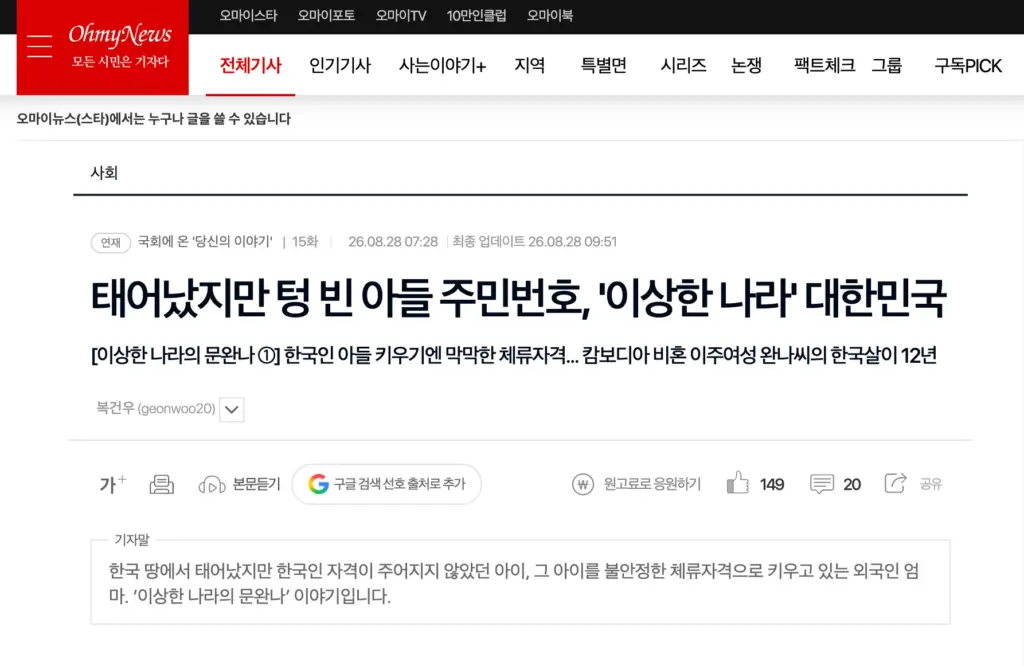
A three-part investigation from Korean outlet OhmyNews looks at a new phenomenon known as K-Kopino, where the Korean-fathered children of migrant women lack citizenship and basic social welfare
Mun Vanna arrived in South Korea from Cambodia 12 years ago after studying Korean in college. Working in the mid-western city of Nonsan, she fell in love with a Korean man and soon got engaged. Two months ahead of their wedding, she became pregnant.
Mun’s dream turned into a nightmare when her future husband said he wanted to break up and asked her to get an abortion. Mun also found out he was already married to another woman in Vietnam.
She decided to keep the pregnancy and her son, Daniel, was born in April 2019. She wanted to return to Cambodia with him, but couldn’t because she lacked the “father’s approval of birth” – a legal requirement in South Korea. Journalist Bok Geonwoo reported on her struggle, and her journey to the National Assembly, in a three-part series for OhmyNews.
The first hurdle was to establish her legal relationship with Daniel. In South Korea, when a baby is born outside of marriage, the birth mother or father must formally recognize the baby for the other parent to be designated as the natural guardian. Mun had to sue Daniel’s father for this – the process took a year.
Only after this could she take steps to obtain Daniel’s South Korean citizenship and official resident registration details. The process took two years, and Mun had to borrow money while navigating her own visa status as a migrant in the country. She lived without any public support or welfare from the government.
Mun applied for an F-6 (Marriage to Korean citizen; F-6-2: Child raising) visa in 2021, but it was rejected because she was unmarried, leaving her with an F-1 (Visiting or joining family) visa instead, which allows very limited employment. Mun now has just 10 years before she must leave South Korea when Daniel turns 19, as the F-1 visa only allows her to stay while her child is a minor. “I want to raise my son as a healthy and proper South Korean citizen,” she said.
But there was hope: Mun visited the National Assembly and met lawmakers Lim Mi-ae and Jeon Jin-suk from the ruling Democratic Party, who were on her side.
“Regardless of who their parents are, children have a right to national support. While the Korean father neglected his responsibilities, the state has failed to fill the gap. We need systemic reform so the government fully supports mothers until Korean children reach adulthood,” said Jeon.
Lim Mi-ae highlighted her proposed amendments to the Family Relations Registration Act and the Immigration Control Act, which are currently pending. She committed to advocating for legislative progress to ensure temporary stay permits for children born in South Korea.
Dr. Heo Min-suk, a Legislative Research Officer at the National Assembly, framed this systemic neglect as the “K-Kopino” phenomenon, where Korean men abandon children born out of wedlock with migrant women. “The core issue is that fathers demand abortions before birth and shirk all responsibility afterward,” he explained. “Leaving these children unregistered means denying their very existence.”
Dr. Heo wants to see the creation of a “Caregiver of a Korean national” residence status, which has similar benefits as spousal visas.
“Current visa policies favour foreign women who marry Korean men. If a mother raising a Korean child lacks access to national pensions or employment, she is not truly granted caregiver status,” he argued. “Providing proper residence and welfare rights to non-citizen mothers is actually far more cost-effective for Korean society in the long run than managing the fallout of social exclusion.”

Summary by contributing editor Yejin Gim
| Yejin’s take: Kopino (a slang term which blends Korean and Filipino) has long been a social issue where Korean men who father children with local women in the Philippines vanish back to South Korea, leaving mothers and children in vulnerable situations. Recently, this phenomenon has been happening within South Korea as well, increasingly referred to as “K-Kopino”. As the article points out, it is deeply unfair that Mun and Daniel must endure exhausting legal battles without basic legal protections. Robust institutional frameworks are urgently needed to guarantee their social safety, and irresponsible Korean men must be held fully accountable for their children. |
Part one of the original three-part series by Bok Geonwoo, ‘태어났지만 텅 빈 아들 주민번호, ‘이상한 나라’ 대한민국‘ first published in Korean for OhmyNews on August 28, 2026.
OhmyNews is an open-source South Korean online news wesite, whose motto is “Every Citizen is a Reporter”. It boasts more than 50 editorial staff, and tens of thousands of freelance contributors.