
Publication Name: Politiken
Founded: 1884
Format: Print and online
Country: Denmark
Languages: Danish, English

In a media landscape increasingly poisoned by AI slop and disinformation, Danish newspaper Politiken is going back to the basics. Line Vaaben is the paper’s “existential editor”, deploying immersive journalism techniques with her team to ask: what does it mean to be human?
“This approach is as old as the Greeks. It’s not rocket science and it’s not new science,” she tells Translator in an interview from her home office in Copenhagen. “Instead of applying a human example to a news story, we work the other way. We think about what would be a really interesting human angle into what’s going on in the world today.”
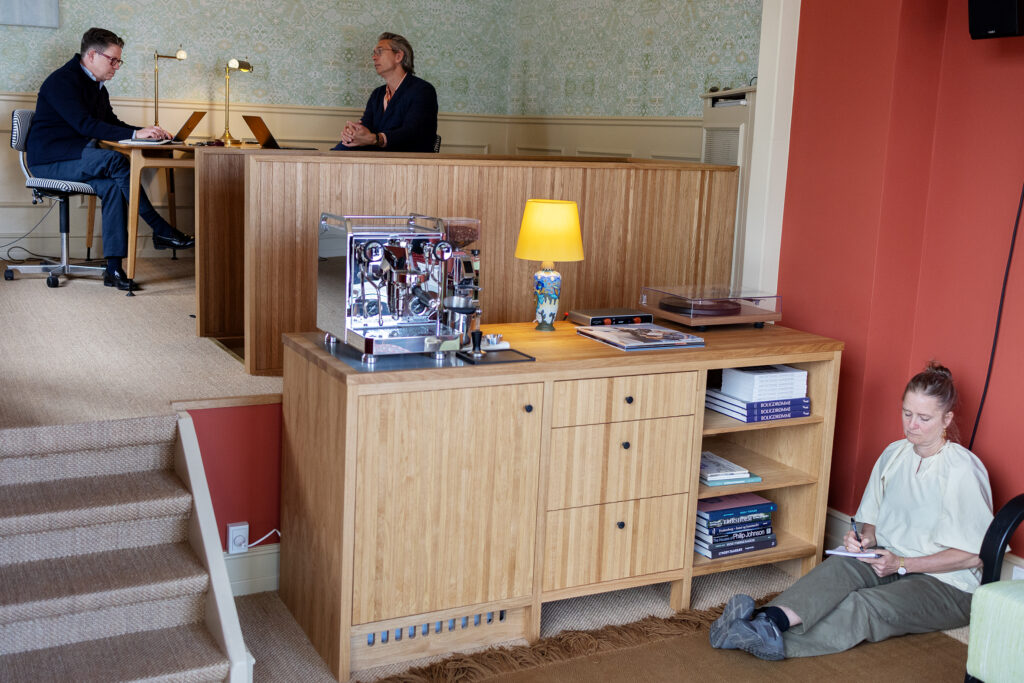
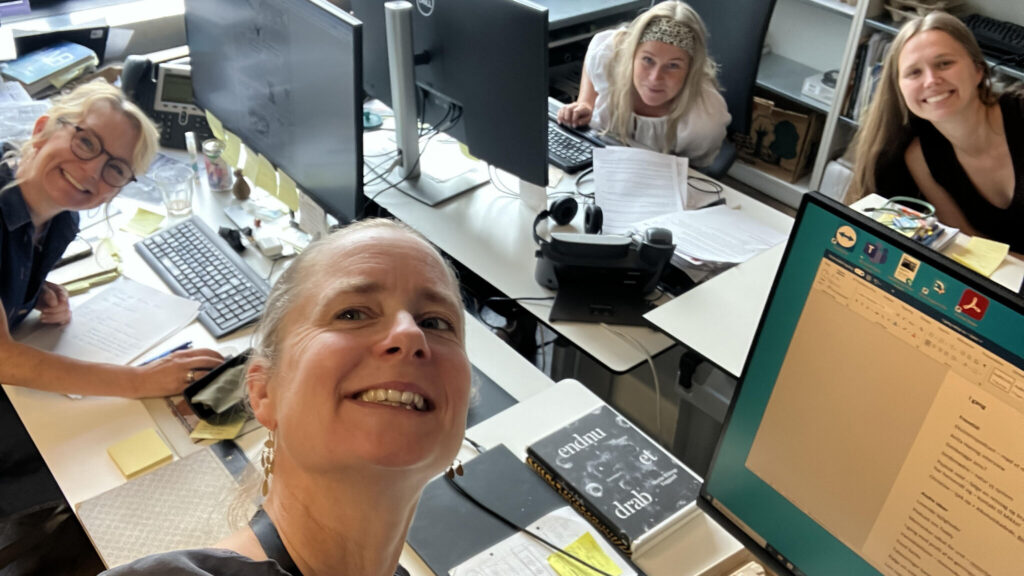
Symbolically located in the middle of the Politiken newsroom, the existential desk is a team of just five people. Stories must be somehow “linked to the zeitgeist”, Vaaben explains, but can cover a range of topics – from women’s health, to reckless driving, climate change and assisted suicide. While immersive journalism (a technique that involves spending significant periods of time embedded with sources) can require more time, resources and access, Vaaben says the payoff is worth it. Existential stories are consistently among the most read at the paper.
“What we see is that people actually want better produced journalism instead of very fast produced mini units because they can get that everywhere,” she says. “When you use your own voice, it is also saying in these times of AI that there is a human present. I’m actually here. I’m trying to tell you something important and I’m doing it with my heart and my voice. And that is definitely engaging people.”
When we spoke, Vaaben was preparing for a two-week immersive reporting trip in Denmark’s biggest maternity ward, as part of a story about the “free birth movement” and women who choose to give birth outside the medical system. She’s previously followed a man for several months before he decided to end his life. And another reporter on her team spent extended periods of time with the family of an elderly couple killed by a reckless driver. Vaaben says they regularly collaborate with reporters, editors, illustrators and designers from other sections of the newspaper. The goal of existential journalism is about helping people better understand each other and, in turn, themselves.
“I think this approach brings nuance,” she says. “The closer you get to a person or a situation, the more difficult it is to form an opinion about. And that’s what I really want. I think the best kind of journalism leaves you more in doubt about what it means to be human than before.”
Below are three of Vaaben’s selections from the existential desk at Politiken, briefly summarised into English.
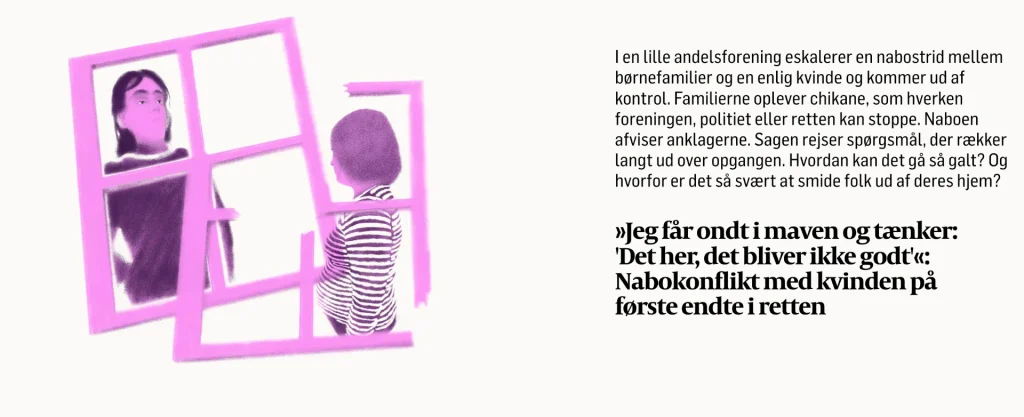
Kvinden på første (The Woman on the First Floor) by Line Vaaben
This story follows a long-running neighbour dispute in a Copenhagen housing cooperative between several families and a single woman living on the first floor. The families accuse her of years of harassment, including deliberate banging, loud music and other disturbing behaviour. The whole thing ends up in court. I chose this story because the case highlights how difficult it is to prove persistent harassment and throw people out of their home. It also raises a broader question: how can residents be protected from destructive neighbour conflicts while safeguarding an individual’s fundamental right to remain in their home? The story is told as a three part series and is also out as a riveting podcast.
The story also tells a lot about us as humans, and what it takes to live close together in urban areas.
Line Vaaben
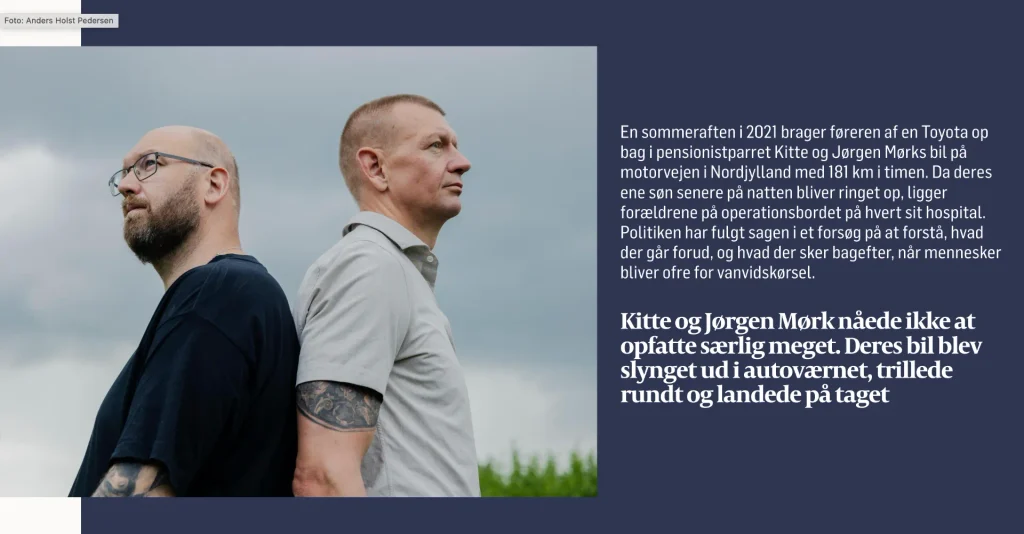
Kitte og Jørgen Mørk nåede ikke at opfatte særlig meget. Deres bil blev slynget ud i autoværnet, trillede rundt og landede på taget (Kitte and Jørgen Mørk didn’t have time to register much. Their car was flung into the crash barrier, rolled over, and landed on its roof) by Elisabeth Astrup
Reckless driving has been on the political agenda and has been debated a lot in Denmark over the past couple of years. And we decided to tell the story through a human tragedy. In 2021, Kitte and Jørgen Mørk were hit from behind at 181 km/h by a driver under the influence of alcohol and drugs. Both suffered severe injuries; Kitte later died, while Jørgen became paralysed and died almost two years later. The driver had already caused another serious high-speed crash just three weeks earlier. Elisabeth Astrup from the existential desk covered the legal which process ended with a two-year prison sentence and a seven-year driving ban.
The story illustrates how reckless driving can devastate not only victims but entire families – and raises questions about whether society does enough to prevent repeat offenders.
Line Vaaben
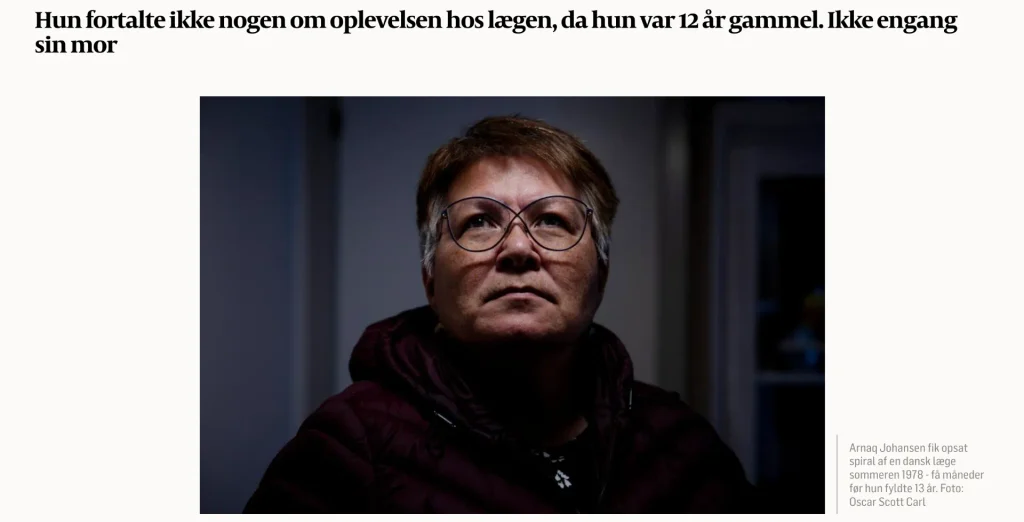
Hun fortalte ikke nogen om oplevelsen hos lægen, da hun var 12 år gammel. Ikke engang sin mor (She didn’t tell anyone about the experience at the doctor’s when she was 12 years old. Not even her mother) by Line Vaaben
An example of a recent article, which taps into the news cycle, and which was made relatively fast, but with a narrative approach in both interviewing and writing. Several decades ago, at the age of 12, Arnaq Johansen was fitted with an IUD by a Danish doctor in Greenland without consent. She later suffered infections and was unable to have biological children. For 43 years, she kept the experience to herself, until she heard other Greenlandic women with similar stories. Around 4,500 girls and women were fitted with IUDs between 1966 and 1975, many without consent, and the practice continued until 1991. The campaign was officially about family planning, but Danish authorities also wanted to reduce Greenland’s birth rate. Today, the case has become a reckoning with Denmark’s colonial history and its control over Greenlandic women’s reproductive lives.
For Arnaq, compensation matters less than recognition of the injustice and an acknowledgement of the shame. I wrote the article, while parliament voted for compensation for the women …
Line Vaaben
Banner image credit: Thomas Borberg