Palestinian writer and editor Muhammed al-Zaqzouq writes about how the war in Gaza has reshaped the concept of fatherhood for him and his children
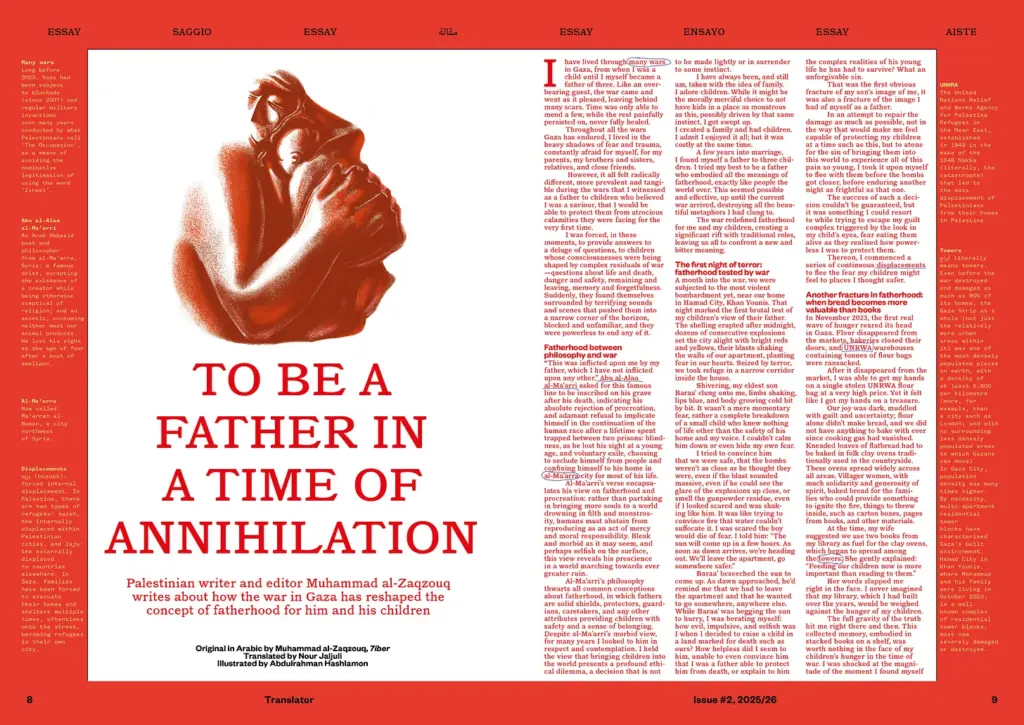
I have lived through many wars in Gaza, from when I was a child until I myself became a father of three. Like an overbearing guest, the war came and went as it pleased, leaving behind many scars. Time was only able to mend a few, while the rest painfully persisted on, never fully healed.
Throughout all the wars Gaza has endured, I lived in the heavy shadows of fear and trauma, constantly afraid for myself, for my parents, my brothers and sisters, relatives, and close friends.
However, it all felt radically different, more prevalent and tangible during the wars that I witnessed as a father to children who believed I was a saviour, that I would be able to protect them from atrocious calamities they were facing for the very first time.
I was forced, in these moments, to provide answers to a deluge of questions, to children whose consciousnesses were being shaped by complex residuals of war – questions about life and death, danger and safety, remaining and leaving, memory and forgetfulness. Suddenly, they found themselves surrounded by terrifying sounds and scenes that pushed them into a narrow corner of the horizon, blocked and unfamiliar, and they were powerless to end any of it.
Fatherhood between philosophy and war
“This was inflicted upon me by my father, which I have not inflicted upon any other.” Abu al-Alaa al-Ma’arri asked for this famous line to be inscribed on his grave after his death, indicating his absolute rejection of procreation, and adamant refusal to implicate himself in the continuation of the human race after a lifetime spent trapped between two prisons: blindness, as he lost his sight at a young age, and voluntary exile, choosing to seclude himself from people and confining himself to his home in al-Ma’arra city for most of his life.
Al-Ma’arri’s verse encapsulates his view on fatherhood and procreation: rather than partaking in bringing more souls to a world drowning in filth and monstrosity, humans must abstain from reproducing as an act of mercy and moral responsibility. Bleak and morbid as it may seem, and perhaps selfish on the surface, this view reveals his prescience in a world marching towards ever greater ruin.
Al-Ma’arri’s philosophy thwarts all common conceptions about fatherhood, in which fathers are solid shields, protectors, guardians, caretakers, and any other attributes providing children with safety and a sense of belonging. Despite al-Ma’arri’s morbid view, for many years I looked to him in respect and contemplation. I held the view that bringing children into the world presents a profound ethical dilemma, a decision that is not to be made lightly or in surrender to some instinct.
I have always been, and still am, taken with the idea of family. I adore children. While it might be the morally merciful choice to not have kids in a place as monstrous as this, possibly driven by that same instinct, I got swept up. I created a family and had children. I admit I enjoyed it all; but it was costly at the same time.
A few years into marriage, I found myself a father to three children. I tried my best to be a father who embodied all the meanings of fatherhood, exactly like people the world over. This seemed possible and effective, up until the current war arrived, destroying all the beautiful metaphors I had clung to.
The war redefined fatherhood for me and my children, creating a significant rift with traditional roles, leaving us all to confront a new and bitter meaning…
This excerpt is taken from Translator Issue #2, out on 20 November. To read on, pre-order a copy of the magazine here.
Original article ‘أن تكون أبًا في زمن الإبادة’ by Muhammed al-Zaqzouq was published in Arabic by 7iber on 22 May 2025.
It is available here.
7iber is an Amman-based media organisation and online magazine publishing in-depth multimedia journalism, critical analysis and public conversation.