
Mapping the city and treasured memories through its smells
I can never seem to navigate my way around this city by sight alone. Instead, I rely on the information diffused in the air and carried on the wind to situate myself in time and place. Partly, it’s a process of botanical identification through different fragrances. The rest depends on how the breeze delivers them to me: with the muddy wetness of spring, or the tang of burning concrete in summer, exhaust fumes in autumn or with the cold edge of winter, needle-sharp. Each season draws its own map.
Bánh đúc A traditional Vietnamese dish made from rice flour, often steamed into a soft, jelly-like cake. Depending on the region, it can be savoury or sweet.

Cestrum nocturnum The scientific name for “night-blooming jasmine” —the epitaph on David Lynch’s grave at the Hollywood Forever cemetry.

Tào phớ A light Vietnamese dessert of silken tofu served in ginger syrup.
Today, the air in Hanoi is thick, like a slice of steamy bánh đúc in the making: slightly sticky and translucent. It reminds me of the smell and feel of the Berlin U-Bahn, with its decades of accumulated body sweat trapped in metal capsules shuttling around underground.
David Lynch’s famous online weather reports spoke of the smell of night-blooming jasmine as the harbinger of spring in Los Angeles. (Now the words are on his gravestone in Hollywood). In place of Lynch’s favourite Cestrum nocturnum, Hanoi at that time of year is filled with the mixed scents of white florals I lovingly call my narcotic street bouquets. Mostly it’s jasminun grandiflorum: you catch it along the pavement and near the water. When it shifts over to the scent of sambac (‘ your-grandmother’s-perfume’), wafting from someone’s garden or a cup of tào phớ, I know summer has arrived.
From time to time, another aroma creeps in which I can’t quite make out at first: a thin, faux jasmine which reminds me of a nasal spray I had in childhood. To me there’s something familiar, even hopeful, about it. On occasion, one can guess the age of the homeowner by the flowers and plants you pass. The mystery scent turns out to be thiết mộc lan—a kind of flower that often stands guard in the garden or at the doorway of a ground-level house passed down from an earlier generation, when a house and a garden were still affordable. When the tree has grown too large to thrive on the balcony it originally inhabited, its faint fragrance lingers on the street like a whisper of a bygone time.
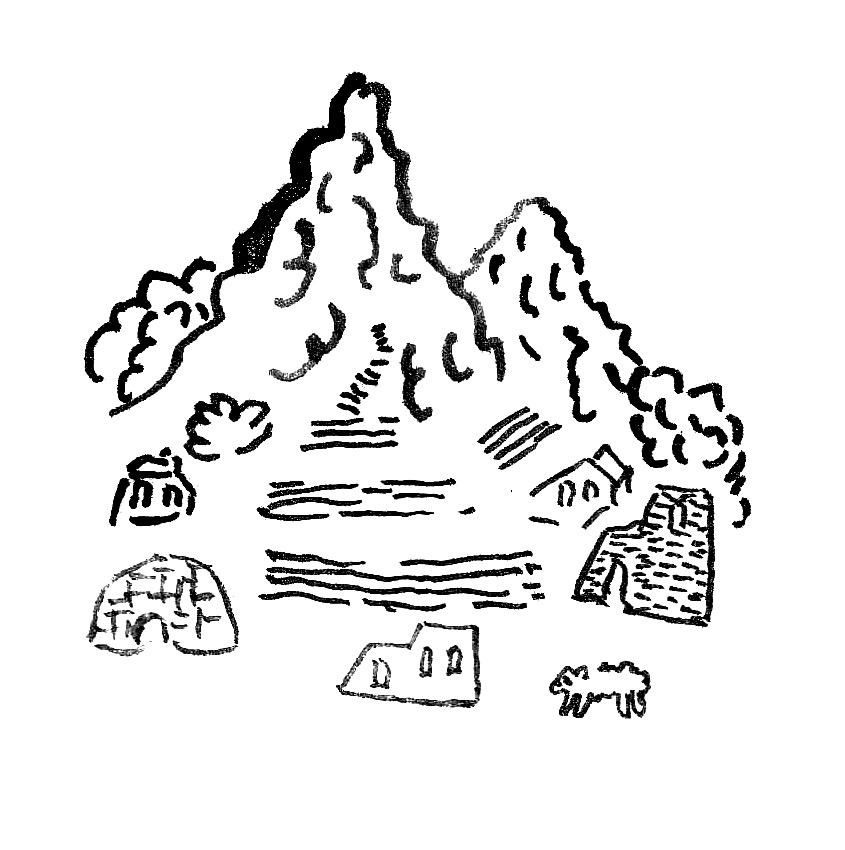
From my balcony, on a clear day, you can see the Ba Vì mountains, the very place where Tản Viên Sơn Thánh—one of the Four Immortals of Vietnamese mythology—resided after a settling historical fight with Thủy Tinh (the Lord of Water—an ancient story about nature and our strange obsession with taming it.
To reach Ba Vì from central Hanoi, you used to pass through the industrial compound known as Cao-Xà-Lá—caoutchouc, sabon, cigarette, a sensory corridor evoking socialism in construction. First it was the processed latex smell of rubber tires. Then a detergent rush—the smell of fabric softener in the making. The weather forecast would never tell you which scent was being made that day. But if it was Nắng Ban Mai, then it would feel sunny even if in fact the sky was moody, carbon heavy. Then came the smell of incipient adulthood, the sun-cured Thăng Long cigarette—vanilla-soft, honeyed and wispy leathery in the air.
Nắng Ban Mai Translates as “fresh morning sunlight”, evoking renewal and the start of the day.A little further to the west, on the way to the mountains, lies the place my grandmother came from. In the 1950s she left to work in the industries of the capital. Her identity became bound up with the city; her natal town was quietly folded into another province, Sơn Tây became Hà Tây. It was only after she passed that I learned that her own real name was Đồng, in reference to the rice field where she was born—the same plot where she now lies in eternal rest. But it’s a place which has so changed its identity over time: once it was the slope of a mountain (Sơn Tây), then the western bank of a river (Hà Tây). Now it’s been swallowed up by a different kind of river, absorbed into the ever-expanding city of Hanoi.
The old factory trio you used to pass through is long gone. The smells of Burley cocoa or the dry hay odour of Virginia blends have evaporated into a sour, musky nothing. Hanoi greets you now with no more dreams—just the brittle odour of rush-hour tires and a sense of manufactured nostalgia, the new housing projects which are almost cities to themselves: Times, Royals, even Smart.
The name Hanoi means “nested inside rivers”, suggesting the movement of land as it grows and dissolves in the flow of its own current. As Vietnam restructures its system of provinces and localities, more birthplaces will soon be dissolved in this way. In Vietnam we say ‘Người ta là hoa đất’, meaning “people are the flowers of the soil”. I wonder if the tradition of giving newborns names which relate to the land will change also.
Perhaps in the future people will stop looking at the motherland through the names of the monuments of nature entirely. Perhaps a future weather report will bear no name of a town at all, but just map out islands of scent rising and falling into consciousness through the scents of memory, in the shape of a breath.