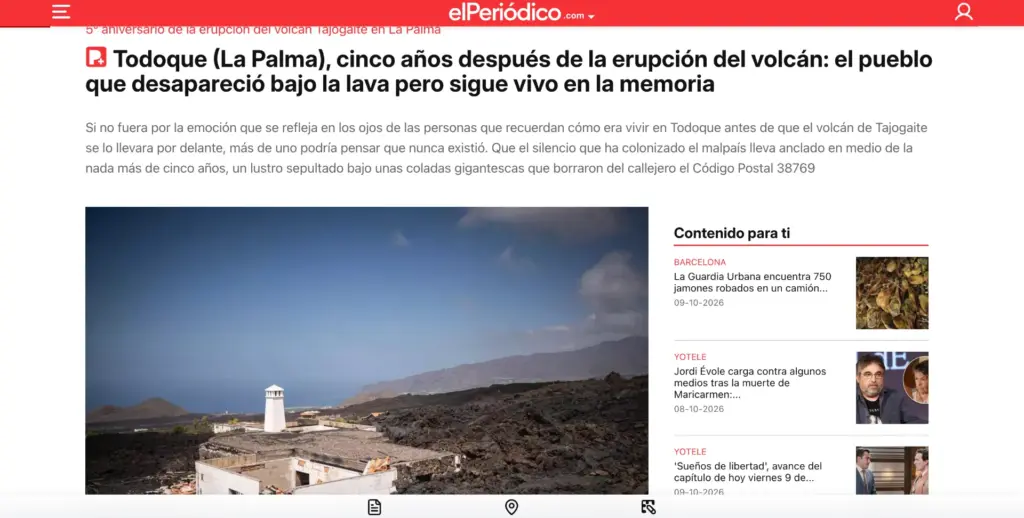
Five years since a volcanic eruption erased the town of Todoque, is there a chance to build a different future?
What would you take if you had just 15 minutes to pack before losing your home forever? Photos, jewellery, or nothing at all? That was the haunting reality of residents in Todoque, La Palma, Canary Islands, a village erased by a volcanic eruption on September 21, 2021. “Todoque has been wiped off the map; it seems as though it never existed,” journalist Jorge Dávila writes in El Periódico.
Today, the village is a post-apocalyptic landscape buried under lava and ash. Only a dog barking breaks the silence. Yet, Todoque survives in the memory of its former residents:
“I was born in Todoque, my parents met in Todoque, my grandparents went to the Todoque festival.”
The town was once a peaceful getaway for holiday makers and home to just over 1,000 people who worked mostly in agriculture. They cultivated a land rich in vines and fruit trees. Farmland was often passed down through generations. But without formal documentation of land transfers, many families had no insurance when the volcano erupted.
“There is money, and people are more or less satisfied with what they have been given [from the government],” said Roberto Leal, president of the Todoque Residents’ Association. But no amount of money can erase the trauma of the disaster, particularly for younger generations, who are rebuilding their lives from scratch.
Still, some residents see the devastation as an opportunity to shape a different future. They have found better-paying, less arduous construction jobs than their former work loading bananas at packing plants.
Fátima Ramos, a survivor and advocate for La Palma residents, accepts that the village she knew as a child will not return. Yet, she is hopeful for a better future: “I don’t know how it will grow … but I do believe that we will have something new adapted to the younger generations.” A new Todoque with pavements, better connections and municipal services, maybe.
Memories and stories preserve what the lava destroyed. As one resident puts it, Todoque “does not exist today, but continues to live in our minds.”

Summarised by contributing editor Isa Jacobs
| Isa’s take: At first glance, this story reads like another account of ecological disaster in a place that may feel far removed to some readers. But I think Todoque deserves our attention. In a way, it is a modern-day PompeiI, but whose residents are still among us. Jorge Dávila’s postcard from this ghost village is deeply touching: we hear the voices of those who survived the disaster, now trying to rebuild their lives and create a future for their children. Pompeii was a thriving Roman city until buried under the ash of Mount Vesuvius in 79 CE. Today, it’s a tourist hotspot, offering a glimpse into Roman life as if frozen in time. Todoque may no longer exist physically, but it remains very much alive in spirit. It survives through people’s stories. Such places are more than a stage for tragedy. The name Todoque already carries a history that eerily anticipates the disaster. It comes from tedote, an Aboriginal word referring to a mountain covered in scrub or a volcanic cone. The same ten/tene root appears in the word Tenerife, which can be read as “white mountain.” In other words, the village that the volcano erased carries traces of a much older relationship to nature and its past inhabitants. Finally, Todoque raises a question that goes beyond financial compensation or reconstruction: what does it actually mean to rebuild a place? While infrastructure can be rebuilt, it is impossible to truly recreate the village where someone was born or where their parents met. As our world today is being dramatically altered by devastating wars and other ecological disasters, this distinction matters. Like Pompeii, Todoque has become a place that tells a story about the people who lived there – but unlike Pompeii, that story is still being written by its survivors. |
Original by Jorge Dávila ‘Todoque (La Palma), cinco años después de la erupción del volcán: el pueblo que desapareció bajo la lava pero sigue vivo en la memoria‘ published in Spanish for El Periódico on September 19, 2026.
El Periódico is a major daily newspaper published in Barcelona, Spain.