As Russia turns to Chinese labour to fill its workforce shortages, migrant workers find themselves caught between unpaid wages, dangerous construction sites and a war far from home
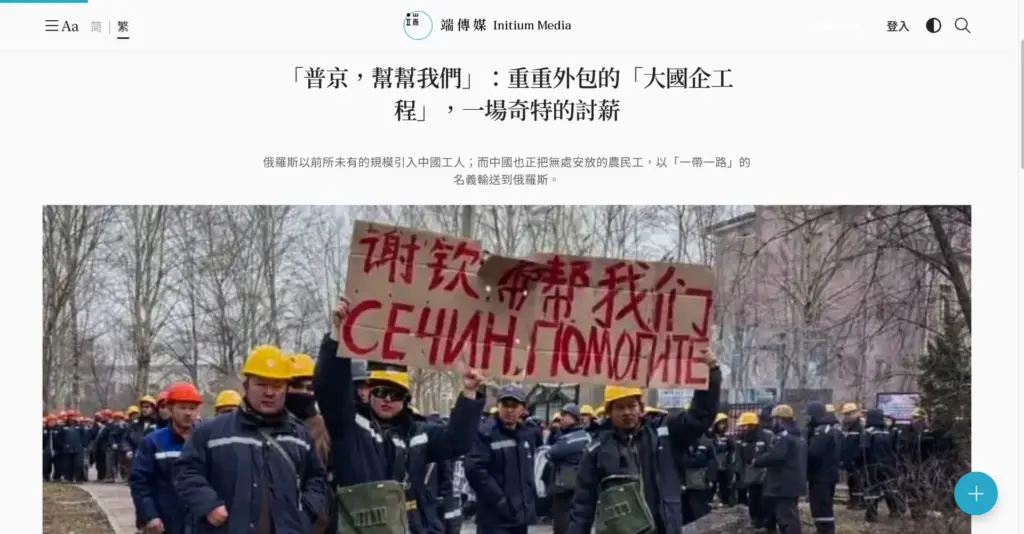
On April 12, dozens of Chinese construction workers marched through Komsomolsk-on-Amur, an industrial city in Russia’s Far East, carrying makeshift signs. One read, in Russian, “Putin, help us.” Another appealed to Igor Sechin, the powerful head of Russia’s state-owned oil giant Rosneft.
The men, mostly in their forties and fifties, had reportedly gone months without pay. Yet footage of their protest showed an oddly subdued scene. Some chatted on the pavement; others sat on the grass or scrolled through their phones. A few called out “No money” to those filming.
In wartime Russia, where even solitary protesters risk arrest, the gathering was extraordinary. Police descended on the city centre, but the workers were initially allowed to disperse without a violent crackdown. Several were subsequently fined for participating in an unauthorised public gathering.
An investigation by Chinese-language independent outlet Initium Media follows the workers’ grievances into a much larger story: how Russia’s wartime labour shortage and China’s shrinking construction industry have created a growing, precarious market for Chinese migrant labour.
The protesters were working on a long-delayed upgrade to a Rosneft refinery, contracted to a Chinese company, Beijing Seawide Oriental Energy Technology Group Limited. Russian regional authorities claimed Rosneft had terminated the contract over poor workmanship and delays, insisting that payments to the contractor had been made. Chinese social media accounts, meanwhile, blamed Rosneft for withholding outstanding payments. The precise circumstances remain disputed.
The refinery has had a troubled history. Originally scheduled for completion in 2015, its modernisation repeatedly stalled. In 2021, Chinese workers staged several protests demanding unpaid wages and permission to return home during China’s pandemic border restrictions.
Five years later, little appears to have changed. Initium contacted workers through Douyin, China’s version of TikTok. Some said they had received their wages; others had not. One worker declined to speak openly, fearing that communications through the Russian-provided internet connection might be monitored. “There are grievances we cannot speak of,” he said. He described 10-hour working days without rest days.
By late May, some workers were posting videos of themselves packing for home. Asked whether he had finally been paid, the same worker replied simply: “No.”
But Komsomolsk is only one corner of a much larger phenomenon.
Near the Baltic port of Ust-Luga, outside St Petersburg, Chinese workers are helping construct an enormous gas-processing and petrochemical complex. In 2019, China National Chemical Engineering signed a €12 billion contract to build its petrochemical plant, one of the largest deals of its kind. One worker told Initium that some 30,000 Chinese labourers were now employed on the project.
Their Douyin videos offer glimpses of life rarely seen in official accounts of Sino-Russian cooperation: endless queues for work, unappetising canteen meals, snow-covered accommodation blocks and occasional drinks after exhausting shifts. For many, the journey was their first trip abroad, sometimes even their first flight.
Although many workers reveal little emotion in their videos, their choice of background music hints at the exhaustion and loneliness beneath the routine. One of the most frequently used soundtracks features a drunken man shouting a song called The Hardest Meal Is One You Have to Beg For: “Alone in a foreign land, who can I tell my troubles to?” Meanwhile, fellow villagers leave comments asking when the workers will return home. “We’re already wearing short sleeves here,” reads one. “Why is it still snowing where you are?”
The dangers extend well beyond isolation. Initium verified reports of fatal construction accidents, including workers crushed by equipment. The nearby port has also become a target for Ukrainian drone strikes. In August 2025, three Chinese workers were injured during an attack. Subsequent strikes sent flames and smoke into the sky, while communications disruptions left workers searching for mobile signals.
The investigation found no evidence in workers’ videos of appropriate safety training following the attacks. In one circulated message, a purported manager even falsely attributed an incident that injured Chinese workers to an operational mistake involving a construction drone, instead of an enemy attack.
Unpaid wages are another recurring grievance. Videos circulated online show workers confronting management and, in one instance, apparently threatening to jump from a building to demand payment. Initium also observed how footage of a wage protest on Douyin quickly became impossible to share or comment on.
Behind these disputes lies a labyrinth of subcontracting. Recruitment agents advertise the Baltic project as a prestigious “major state-owned enterprise project”, implying security and reliability. But ordinary labourers often have no direct employment relationship with the Chinese state-owned main contractor. Instead, they are hired through layers of subcontractors, labour brokers and work teams. When wages disappear, responsibility becomes difficult to pin down.
The arrangement allows major companies to distance themselves from workers’ grievances, even as they profit from enormous international contracts.
There is a further paradox. Russia needs these workers because its invasion of Ukraine has drained the domestic labour force through military mobilisation, emigration and expanding defence industries. According to figures cited by Initium, Chinese arrivals for work doubled from 66,000 in 2023 to 132,000 in 2025.
China, meanwhile, has its own employment crisis. The collapse of its property boom has eliminated construction jobs, pushing labourers to seek opportunities abroad. Overseas projects promoted under the Belt and Road Initiative offer a possible escape, although the number of workers dispatched overseas remains tiny compared with the jobs lost domestically.
And Russia’s industrial ambitions may themselves be economically questionable. The Ust-Luga complex was conceived largely to supply European markets, which have since sought to reduce their dependence on Russian energy. China, already facing petrochemical overcapacity, has little reason to import its products from halfway around the world.
Yet for the workers, such geopolitical calculations are distant concerns. On Douyin, beneath videos of bitter cold, dangerous worksites and lonely evenings, the most common questions are not about Russia’s future or China’s economic strategy.
They are simpler: “Are you still hiring?” “Does your site need ordinary workers?” “Brother, can you take me with you next time?”
The answers, when they come at all, are often just as brief: “Full.” “Not hiring.” “Wait a little longer.”

Summarised by contributing editor Kin-Long Tong
| Kin-Long’s take: This story connects two transformations rarely examined together. English-language coverage of China and the war tends to focus on great-power politics: Xi and Putin, sanctions, energy and Beijing’s support for Moscow. This story offers a human perspective largely absent from Anglophone media: how geopolitical decisions travel downward into the lives of people with almost no power over them. |
Original, ‘「普京,幫幫我們」:重重外包的「大國企工程」,一場奇特的討薪’ by 龔玨 Gong Jue first published in Chinese on Initium Media on June 8, 2026.
Initium Media is a Chinese-language digital media outlet based in Singapore.