For Syria’s Kurds, integration with the state comes at a cost
The word Rojava means “where the sun sets” in Kurmanji Kurdish. It is also the name given to a region of north-east Syria, one of the four divided parts of wider Kurdistan, the ancestral homeland of the Kurdish people.
four divided parts: The other parts are in Iraq, Iran and Turkey (Başûr, Rojhilat and Bakûr respectively)Rojava emerged as an autonomous political entity amid the US-led fight against ISIS and the collapse of the centralised Syrian state under former president Bashar al-Assad. At its height, Rojava comprised one third of Syrian territory. Its governance inspired people around the world as an example of grassroots democracy, priding itself on its principles of feminism, ecology, cultural pluralism, participatory politics and a cooperative sharing economy.
Even after the final fall of the brutal dictatorship of al-Assad in December 2024, this land still can’t find the peace it deserves. In January 2026, a new conflict broke out between the Syrian transitional government and Syrian Democratic Forces (SDF) fighting to preserve Rojava’s autonomy. After weeks of bloodshed, a ceasefire was agreed: Rojava would be officially integrated into the Syrian state.
But now, the Kurdish language, culture, traditions and identity are becoming a battleground once again.
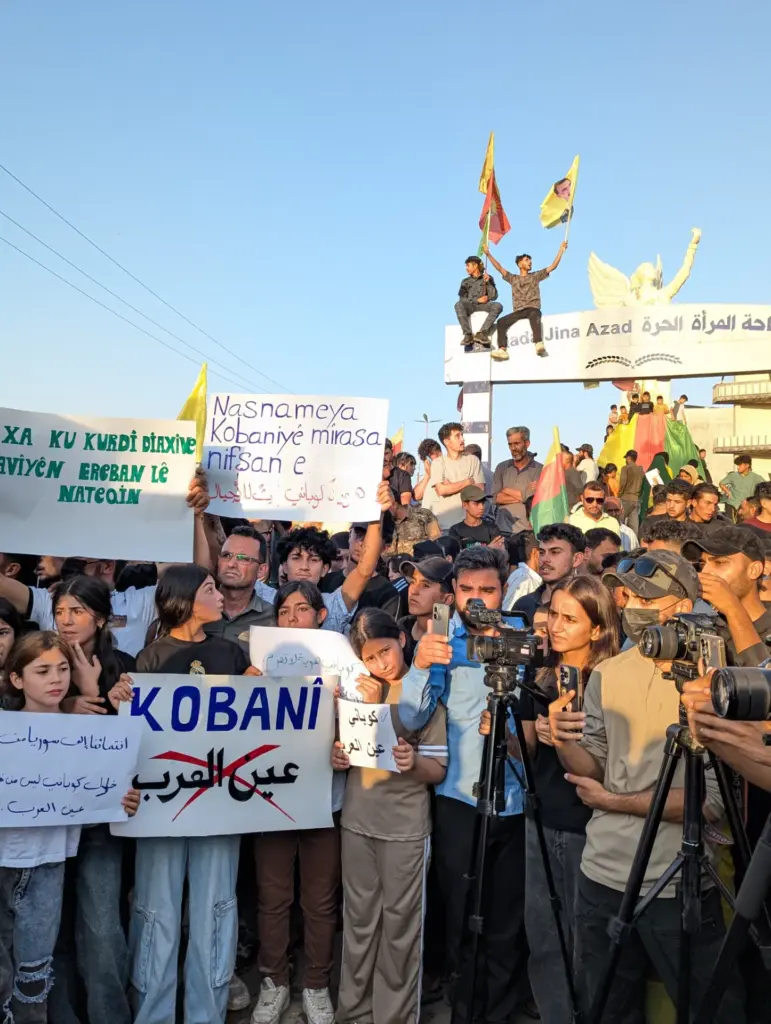
This reality is playing out in seemingly small but highly significant ways. To promote national unity, the transitional government in Damascus under Ahmed al-Sharaa says it wants to return cities such as Kobanê – a symbol of Kurdish resistance – to their Arabic, Assad-era names (in this case, Ayn al-Arab).
“What are the names of our villages or towns now?”
We Kurds ask ourselves this question every time we travel. Should we use their Kurdish names, like our parents and grandparents? Or their Arabic names, imposed by successive authorities who denied us our freedoms? We are grappling daily with this erasure: a reminder of how political power shapes our identity.
And yet we refuse to stay silent. In May, thousands of Kurdish people protested when the transitional government removed Kurdish words on signs on the local ‘Palace of Justice building and replaced them with English and Arabic in the town of Hasakah. Kurds tore down the new signs five times before the government brought in special forces to guard the building. The signs remain in English and Arabic only.
Last month, pupils at around 20 schools in Qamishli and elsewhere boycotted classes over cuts to Kurdish-language schooling. A ministry decree has made Kurdish part of the curriculum in Kurdish-majority areas, but only as a subject taught for three periods a week with schooling otherwise in Arabic. Under the January 2026 agreement, Kurdish is recognized as a “national language” but unlike Arabic, it is not an official state language, which means it can’t be used in official state institutions or at the judicial level.
In today’s Syria, Kurdish is being erased in much the same way as other indigenous languages around the world. We fear that Kurdish, a language with several dialects spoken by tens of millions of people denied a homeland in the Middle East, is being reduced to mere folklore. We dread further oppression, like in neighbouring Turkey, which violently represses Kurdish cultural identity it deems an existential threat to Turkish sovereignty.
But our battle today is about more than language or place names. The deeper issue is that rulers pursue their own nationalist ambitions, while ordinary people must live with the costs. “Qey em disa vedigerin bin zilma Asad” (We are returning to the dark days under Assad).
The Kurdish language doesn't use double consonants, so Asad or Assad are the same.
This is a common sentiment in the streets of Rojava today, especially among people like me, who remember the fear and repression of the previous regime.
I grew up under al-Assad’s totalitarian rule, in a household where we only spoke Kurdish. To avoid paying a bribe to register my Kurdish name (Mamo Seydi) at birth, my family was forced to officially register me under my Arabic name (Khalil Muhammad). At school, I was punished for speaking Kurdish: لا تحكي كردي ولك حمار عرص. “Don’t speak Kurdish, you filthy donkey!” was a common utterance of teachers. One time when I was playing football, I inadvertently called out to my friend in Kurdish. The principal, a pro-Assad Arab, overheard. He stopped our game and I was punished with a beating on the feet.
Being a student under Assad felt like being a robot: you stayed in your place and moved only when ordered. There was little room to question, express yourself, or simply be who you were. Assad’s policies intended to change the demography of the Kurdish region, weaken the identity of its people, and scatter the connected regions.
For language recognition is meaningless if it is not paired with recognition of our rights and freedoms.
The purpose was to control the present while shaping the future. When you control a person’s language, education, history, and even the name of their hometown, you are not simply controlling their daily life – you are trying to influence how they understand who they are.
We Kurds remember what it is to be denied our names. So when the new Syrian government says it will “recognize” our language, we know better than to trust it. For language recognition is meaningless if it is not paired with recognition of our rights and freedoms. After living for so long under oppression, trust does not return overnight. When the war ends, freedom is not only about putting down weapons. It is about feeling that your identity belongs to you again.
Khalil Muhammad is a freelance journalist, fixer, and human rights monitor based in northeastern Syria.
Featured image: Civilians in Kobanê protest the transitional government’s decision to rename the town by its Arabic name, Ayn al-Arab, in July 2026.