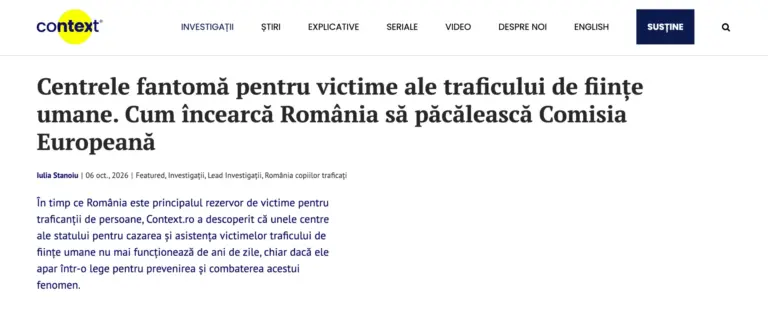
Bucharest told the EU it had shelters for victims of trafficking. Some had been closed for years
For years, the Romanian government has reported having a network of specialised shelters intended to provide accommodation and assistance to victims of human trafficking, as required by national legislation. An investigation by journalist Iulia Stănoiu, published by the independent Romanian publication Context.ro has found that several of these state-run facilities have been closed for years, while others no longer provide essential services such as psychological counselling, medical and social assistance, food, medication and safe accommodation, as required by Romanian law. Some have been out of operation for as long as 13 years, yet remain listed in Romania’s anti-trafficking legislation and are included in reports to the European Commission.
The situation is particularly concerning given the scale of human trafficking in Romania. According to figures cited by Context, more than 3,300 victims have been identified over the past five years, including over 1,600 children who required specialised care. In 2024, authorities recorded 610 victims, 333 of whom were minors. Figures from the Ministry of Labour that same year show that only 26 people received assistance in four state-run residential centres. The investigation acknowledges that some victims may have received support from NGOs or other public social services, including child protection centres and programmes for victims of crime, but while some NGOs provide specialised assistance, other facilities are designed to support a broader range of vulnerable people and may not offer the specific psychological care and protection needed by trafficking survivors.
The findings also come at a time when Romania is facing scrutiny over its implementation of European legislation on human trafficking. Under a revised EU directive, which countries were required to incorporate into national law by 15 July 2026, victims must have access to specialised assistance and safe accommodation suited to their needs, including those of children and people with disabilities. Romania reported 12 existing laws and regulations to the European Commission as evidence it had met these requirements, including a 2001 law providing for trafficking victim shelters in nine counties. However, on 25 September, the Commission opened infringement proceedings against Romania for failing to fully incorporate the revised directive into national law. Although the proceedings concern broader legislative obligations, the investigation raises questions about how to hold states accountable in reporting shelter availability for those in need.
According to Context.ro, years of insufficient funding, weak coordination between public institutions and incomplete records of the assistance provided to victims have made the situation worse. National strategies have repeatedly acknowledged resource shortages, while the National Agency Against Trafficking in Persons has been unable to specify the support given to every identified victim. Journalists approached several institutions and officials who declined to give interviews.
Summarised by Romanian journalist Georgiana Costea
| Georgiana’s take: What I find most disturbing about this investigation is how long these failures have been allowed to persist, despite the existence of laws, national strategies and institutions specifically designed to protect victims of trafficking. I keep thinking about the people who are trapped in exploitative situations and what it must mean for them to consider escaping when they cannot be certain that a safe place or adequate support will be available. Trust in public institutions is difficult to build under such circumstances, especially when the people depending on them are already in extremely vulnerable positions. I believe this investigation deserves far more attention in Romania and should lead to a serious public discussion about accountability, including what authorities have done to improve the situation. However, I doubt such a discussion will take place, or that anyone will be held accountable; when the investigation was published, Romania was going through a political crisis, and public attention was largely focused on political developments and debates over the country’s public finances. So the findings received relatively little attention, and I fear they may be forgotten without prompting any meaningful response from the authorities. I would also like to see it encourage journalists and civil society organisations elsewhere in Europe to examine their own protection systems, because similar failures may well exist beyond Romania. |
Original ‘Centrele fantomă pentru victime ale traficului de ființe umane. Cum încearcă România să păcălească Comisia Europeană’ first published in Romanian by Iulia Stănoiu for Context on October 6, 2026.
Context is a Romanian independent media start-up focussed on corruption, fraud and organized crime.