As the dust settles on two of the most consequential elections this year, Translator’s digital editor sits down with a Brazilian and a Serbian journalist to talk about the outcome – and what comes next
Voters in Brazil and Serbia went to the polls on October 25 in elections that many saw as a fight for democracy itself. In Brazil, incumbent Luiz Inácio Lula da Silva staged a dramatic comeback, defeating Flávio Bolsonaro, son of the jailed former president Jair Bolsonaro, who had floated a longer term in office and impeaching Supreme Court justices. Meanwhile in Serbia, two years of student-led protests helped topple Aleksandar Vučić, whose 14 year authoritarian rule was marred by corruption.
But the street celebrations in the aftermath only tell part of the story. Journalists Laís Martins and Bojana Jovanović on the fear many journalists felt before the vote, what foreign media missed, and why Brazil’s far-right Congress and Serbia’s unfinished corruption cases mean the work is far from over.
Laís Martins is an investigative journalist with The Intercept Brasil based in São Paulo.
Bojana Jovanović is an investigative reporter and deputy editor of the Serbian investigative portal KRIK .
Maxine Betteridge-Moes is the digital editor at Translator.
This conversation has been edited for brevity.

Maxine: The elections in Brazil and Serbia were widely reported in English media. Were there any angles or issues that you felt were missed or under-explored in some of the mainstream coverage?
Bojana: From my experience, a lot of journalists that came here to report about the elections were pretty unprepared … I don’t think that a lot of them actually knew about the potential violence that could happen during the elections. Before coming to Serbia, a lot of colleagues tried to get some help from us local journalists. And I could see that they are not really familiar with how the government used criminals and hooligans to protect them during the elections and potentially after. So I think that a lot of colleagues came to report about the atmosphere on the day, but didn’t know that the atmosphere could turn into the real violence. Luckily, it didn’t happen. The focus of most of the media was showing the celebration on the streets after the elections and that the [Aleksandar] Vučić government is over after 14 years.
Laís: I agree. I think what bothered me especially about English media coverage was the lack of context. This is true also for legacy media in Brazil. They were covering this as if it were normal elections with two candidates and they’re running against each other. What was missing was the fact that democracy was at stake. Flávio Bolsonaro had been very vocal in his promises of what he planned to do once he became president. He spoke of having a longer term or even trying to impeach Supreme Court justices. The result was that people from the outside were maybe reading these elections as if it’s a right against left elections. No, it’s actually democracy against autocracy. And this, I think, is because foreign outlets are stuck on this US tradition of objectivity, where they have to cover both sides equally and treat both candidates equally. In Brazil, what happened was a breakdown of this idea.
Foreign outlets are stuck on this US tradition of objectivity, where they have to cover both sides equally and treat both candidates equally. In Brazil, what happened was a breakdown of this idea.
Laís Martins
I was very happy to see many big journalists in Brazil pointing out these are not normal elections, like the conditions are all off. We have an electoral court that is leaning towards Flávio Bolsonaro because the justices there were appointed by his father (former president Jair Bolsonaro). We have Meta interfering in the elections, and this has favored Bolsonaro’s campaign. So these journalists, the fact that they were able to speak freely and say “I will vote for Lula because democracy is at stake” is a game changer. This had never happened before. Again, also agree with Bojana because what happened after Lula won, the images out of Brazil were also like the images out of Serbia, right? The streets were crowded, people celebrating. I think what didn’t make it into the news was how people were fearing for their lives. We’re talking about homosexual people who would probably be at risk, women whose rights could be attacked under a new Bolsonaro presidency, indigenous rights, the future of the Amazon … I think all this was very real. People were very scared. The days leading up to the election were very weird days in the sense that, you know, the vibe was very heavy. People were grieving for something that could happen.
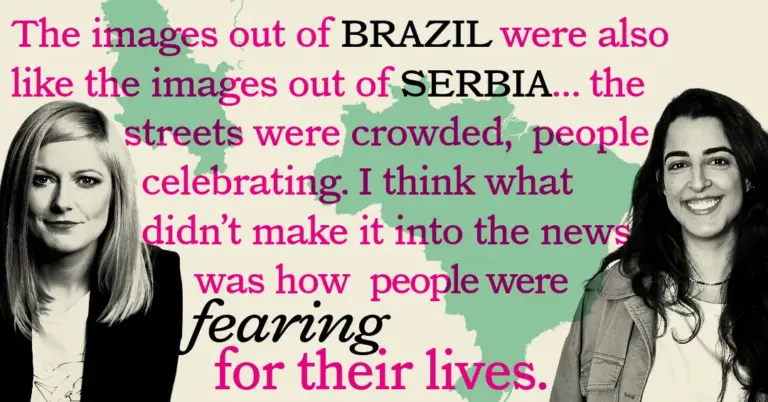
The images out of Brazil were also like the images out of Serbia … the streets were crowded, people celebrating. I think what didn’t make it into the news was how people were fearing for their lives.
Laís Martins
Maxine: On this point of the myth of objectivity and neutrality … was it similar in Serbia?
Bojana: No, I don’t think that we had that problem. We have two different sides when it comes to media. We had propaganda media for Vučić and his government, and we had independent media. But as Laís pointed out, the fear of the elections, the fear of what will happen after if the “bad” option wins … I didn’t see a lot of reporting about that prior to elections in global media, only after it. For some organizations and people in Serbia, those elections were basically death or life.
For some organizations and people in Serbia, those elections were basically death or life.
Bojana Jovanović
For us as investigative journalists, those elections basically meant that if the previous government win elections, we would probably need to shut down the organization and leave the country. In my opinion, it wasn’t really pointed out in foreign media because it was similar as in Brazil. The elections came after two years of students protesting in Serbia. I think it was the most important thing, showing how diaspora acted, how they organized to vote, and how the government actually tried to stop a lot of people from voting. I think that that was basically the proof of the importance and the fear of what the elections will give us.
Laís: I think this is so real, Bojana. And even within, you know, my family and my friends, I found it so hard to make them understand or help them understand the fear that we felt as journalists. Of course, I think the case in Brazil isn’t as serious as you just mentioned, but I had this conversation with friends who were speaking about where to go in case Flávio wins. Because our names are very up top on a list of journalists that has been investigating heavily the Bolsonaro family. I would try to tell people around me that I’m scared for my life. Not that Flávio Bolsonaro will get a gun and shoot me, but he empowers his voters to go against journalists. It’s enough that I find one person in the street who feels ready or feels empowered enough to attack me when I’m doing my work for the tragedy to happen. So I’m actually afraid for myself, for my colleagues. I don’t think it’s okay to open my work email and receive a death threat. I don’t think that’s normal. I stand in solidarity with the feeling that you guys had in the hours leading up to the election because we were feeling the same here.
I stand in solidarity with the feeling that you guys had in the hours leading up to the election because we were feeling the same here.
Laís Martins
Maxine: The months leading up to the election in Serbia were some of the most dangerous for journalists. Can you paint a picture of what that felt like reporting on the ground, Bojana?
Bojana: We are having problems and pressure from the government since we established our organization 11 years ago. And over the years, I remember myself saying it can be worse. And then living worse and worse and worse and more and more pressure. But reporting about the government and the corruption became more and more dangerous because the ruling party captured all the institutions in Serbia. You don’t have [reliably independent] police. You cannot count on prosecutors. You cannot count on courts, on judges. Basically, you have just other colleagues, solidarity among us, and international organizations in support of the colleagues and civil organizations in the country. If you receive a death threat or if somebody pops up at your door, there’s nobody who can protect you.
Journalists reporting on the protests in the streets were attacked by policemen, even though they had a Press sign and IDs on them. The prosecutors never investigated the cases. Nobody was brought to justice.
Journalists reporting on the protests in the streets were attacked by policemen, even though they had a Press sign and IDs on them. The prosecutors never investigated the cases. Nobody was brought to justice.
Bojana Jovanović
Laís: The situation is so different when the “bad” side is in government, right? I think the fact that here they were running against the sitting government made it different in the sense that they didn’t really have
this whole apparatus that would have made our work and any type of resistance so much harder.
Again, I feel that we don’t take it so seriously until it reaches our country, but we have so many examples of what happens when these people take power. And I think the line in Brazil, like my biggest takeaway, is that we saw Trump the second time was so much worse. This is exactly what would have happened with Flávio Bolsonaro if he won.
Maxine: Do you both feel like this experience of covering these elections will shape the way you do your work going forward?
Laís: Yeah, I don’t know if Bojana shares this feeling, but I’m still trying to absorb what happened. It’s very historic. I’m still digesting. But while it’s true that Brazil dodged a bullet with Flávio Bolsonaro, we are going to the worst Congress of our history. I think it’s going to be a challenge for journalists because it will mean that we need to increase our investigations into the legislative houses, this type of power. This is an extremely far-right Congress and they have enough votes now to take down rights, to dismantle a series of pre-established rights since the end of the dictatorship. So it could have been worse, but it’s still going to be bad.
But for me, it has confirmed that to be neutral in the face of something horrible is to be complicit. And I know this could bother so many journalists. It could cost me, you know, potential other jobs in the future because I don’t think this firm position is appreciated by many places. But I am so happy with my decision to call things for what they are, to use my capacities as a journalist to investigate these people who were attempting to again take over the government. I am able to sleep well at night because I know that I did the best work. I think this was a win for investigative journalism in Brazil. And as Bojana said, independent journalism. It really elevated why we do our work. It made it meaningful. It made people realize the value of the work we do and why we need to be independent.
For me, it has confirmed that to be neutral in the face of something horrible is to be complicit.
Laís Martins
Bojana: I totally agree about this being a historic moment in my life. I’ve been working as an investigative journalist for 16 years. And out of these 16 years, 14 years were under the Vučić government. I don’t know how to work when Vučić is not in the power, which is why I’m also really looking forward to the new age in the country. We still have some unfinished business with the previous government because there are a lot of huge corruption cases that are still ongoing … but I’m really looking forward to investigating some new faces, some new names, and to be what we are always: a watchdog of democracy.
Laís: It’s a new dawn, right? I remember the first month after the end of Jair Bolsonaro’s government, I was like, “do I know how to work under a normal government?”
When I look back at the past years in Brazil, we went from Lula was arrested, Bolsonaro was elected, then Lula’s in prison, he becomes free, he runs against Bolsonaro, he wins. Bolsonaro went from being president to being in jail. History can move so slow, but also so fast, right? In 4 years, we had so much change in Brazil. So I hope the same thing happens for you that you’re able to also hold [the government] accountable [in Serbia].
I’m really looking forward to investigating some new faces, some new names, and to be what we are always: a watchdog of democracy.
Bojana Jovanović
Bojana: When Vučić said that he lost elections, there was a huge gathering in Belgrade and everywhere in Serbia. Some of the people approached me because they recognized me and they were thanking me for the job that Krik had done during the government because a lot of things would stay hidden otherwise. And I think this really the biggest award. When somebody tells you that, this question of why do you still do this job is actually answered.
Laís: I got goosebumps when you said that. I think it’s so hard to measure impact when you’re under an autocracy, right? It’s like this very solid rock, but you’re slowly chipping away at it. And I think this is what our work does and it makes a difference. I’m so happy you got the recognition.
It’s like this very solid rock, but you’re slowly chipping away at it. And I think this is what our work does and it makes a difference.
Maxine: Do you also feel like people have a new appreciation or respect for journalism, Laís?
Laís: I think in Brazil, it became clear that we need to find ways to fund independent journalism. At The Intercept, where I currently work, we saw an increase in donations and people wanting to donate money to fund our work. I got so many emails from readers also saying thank you for your stories. So I think there is a new appreciation. I hope this also means a new understanding of why we need to protect, especially independent journalists, freelance journalists who are oftentimes
not protected by the institutions.
Bojana: I think that in Serbia, because of this autocratic government, a lot of people already know that independent journalism is really, really important. Our national broadcaster was also under the influence of the ruling party. I think people understood that it’s not enough to just watch national broadcaster and they understood that they are lying. Our readers are there whenever we are facing any problems. With the SLAPP [Strategic Lawsuit against Public Participation] cases and unlawful lawsuits that we have, our readers want to donate enough money so we can pay all the expenses, which is really, really important because we need money in order to continue working and publishing. I always say we have the best audience ever because they are ready to support us whatever we need.
Maxine: Now that the election hype is over, what’s one thing that people outside of Brazil and Serbia should be paying attention to in your countries?
Laís: I would say two things: one, keep paying attention to Brazil because we need everyone’s eyes. This Congress very likely will try to dismantle environmental protections in the Amazon, which is important not only for Brazil, but for the entire world. The other thing is Brazil will be very hot on the tech regulation front. What happened with Meta made it very clear that these are foreign companies allied to Donald Trump who are interfering in elections outside of their country. Lula, in his victory speech, vowed to regulate tech companies and Big Tech. So I think we’re going to see increased pressure on regulation, and of course, Big Tech lobbying will push back. But I think what will happen in Brazil in the next few years should be very interesting to offer also alternatives to how we engage with these platforms that
we now know are not very democratic.
Bojana: I think the focus now should be the new government. But we still need to hold the previous government to account. We have a lot of people in important positions and we will need years to reconstruct the society and to make things better.
Bojana Jovanović is the deputy editor and one of the co-founders of KRIK. She also serves as the editor of daily content and coordinates the newsroom’s investigative work. She has led groundbreaking projects at KRIK, including The Black Book, a database of mafia murders in Serbia and Montenegro, as well as the award-winning Database of Assets of Serbian Politicians and Judge Who Judges.
Laís Martins is an investigative journalist based in São Paulo, Brazil. Her coverage focuses on technology, human rights and politics – and what lies at the intersection of these topics. She is currently a reporter with The Intercept Brasil, but her work as an independent journalist has previously been featured in prestigious international and Brazilian media outlets.