A Colombian journalist travels to the Sahrawi Arab Democratic Republic to meet the embattled people struggling against a 50-year displacement from their homeland
It’s three in the morning on the outskirts of Tindouf, the biggest city in southwestern Algeria.
The plane, flying in from Algiers, touches down in the middle of darkness. As the aircraft doors open, the dry air sticks to our faces like permanent makeup. The Sahara desert’s 32 degree heat rises up through the soles of our shoes, turning them into bona fide firepits.
The Algerian official looks at our passports with disdain and, in rough French, orders us to quickly fill in the immigration forms. Less than a metre away, at the same table, the Sahrawi official smiles and clarifies in Spanish that not all Algerians are this tiresome. “Welcome to the Sahrawi Arab Democratic Republic (SADR)!” he says.
Sahrawi Arab Democratic Republic (SADR)
The SADR claims sovereignty over the former Spanish colony of Western Sahara. It’s recognised by a number of mostly African and Latin American countries, and an African Union member since 1982. The US recognised Morocco’s competing claim in 2020, in the context of the Abraham Accords with Israel. Colombia reversed its recognition of SADR in August 2026.
Our passports are handed over to another Sahrawi official dressed in civilian clothing who takes them. The airport, which has nothing more than a waiting room, two vending machines and a small souvenir shop, empties out in the blink of an eye. The Algerian officials disappear like ghosts. Meanwhile, the Sahrawis wait for one of them to be courteous enough to come back and complete our entry formalities into the country.
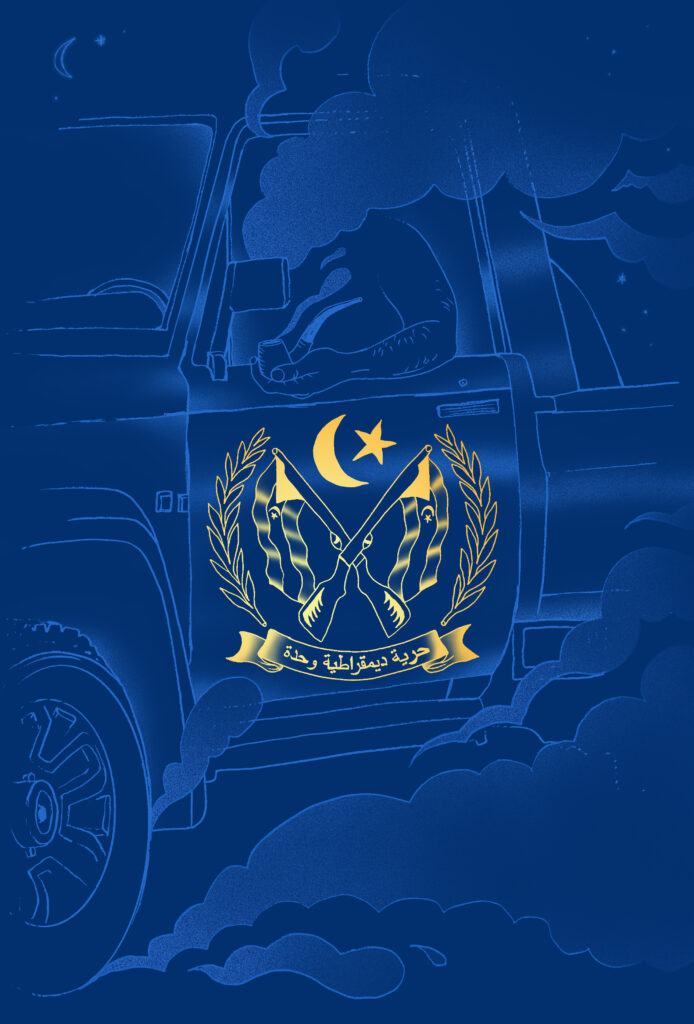
The driver of an old Toyota Land Cruiser pickup with the SADR coat of arms on both sides lights a tobacco pipe to fight back his tiredness. He makes a call on his mobile phone. His Arabic is a rollercoaster of contrasts: barely whispered short words interspersed with long, outbursts of impassioned speech. Either the heat or the conversation becomes so overwhelming that he decides to remove his turban. The reflection of the full moon glints off his bald pate.
Tobacco pipe
In Spanish pipa; likely referring to the long pipe traditionally used in North Africa.
After a wait of an hour, two Algerian police cars turn up. Our driver abruptly ends his phone call. The police lower the tinted windows of their car and give the OK. The Toyota is placed in the middle of the convoy. We’re like a desert troop, says the driver in Spanish while he fits his turban back onto his head. He suggests not opening the vehicle’s windows unless “we want to fill our lungs with sand.”
“Our passports?”
“Don’t worry.”
“Yes, but where are they?”
“It’s a question of national security.”
The Toyota makes a tremendous racket. The two front seats are covered in camel skin. A sense of torpor inside the vehicle seeps into our bodies; sweat creeps over our skin like lava flows. The convoy crosses a large area with less life in it than an ossuary. We drive in complete silence at 80 kilometres an hour with rotating blue and red lights. It’s awesome.
Our desert troop arrives in Tindouf. Like a theatre curtain lifting to reveal a scene of the night’s mysteries, we are introduced to the now-deserted city along wide streets flanked with dunes and palm trees, adobe buildings with domes and friezes in the Islamic style, and armies of cats battling between the bins. The buildings are adorned with lots of Algerian flags, their walls painted with murals of the country’s national heroes.
Adobe buildings
Structures built from mud brick (adobe).
A little over 30km from the city, a fresh boundary marks the start of the refugee camps. The border is a zigzag of enormous piles of cement and metal in the shape of giant asterisks. It’s there, in a dimly lit hut of 20m2, that our passports reappear. The Algerian police is history; from now on, it’s the Polisario Front which calls the shots.
Giant asterisks
Tank traps, most likely.
The driver asks to speak with the person in charge of accommodation arrangements. It’s five in the morning by now. Our sense of exhaustion increases when we try to call her four, five, six times without success. “Now we really are stranded. Let’s sign the agreement”, the driver suggests. Pulling up in a square bordered by uneven piles of sand, he gets out of the Toyota, walks for 20m and frantically knocks on a door painted with the symbols of the Sahrawi flag: a half-moon and a star. He shouts in Arabic. A young man opens the door. Sleepily, he invites him inside.
“Our passports?”
“Don’t worry.”
“Sure, but when will we get them back?”
“It’s a question of national security.”
The driver reappears with an antiquated, school-sized notebook in his hands. He asks us to sign next to our names. Everyone who comes is from Europe. Few come from as far away as you, he says. He returns the notebook to the young man, who, performing a military salute, closes the door in his face in a way that makes it clear he doesn’t want to be bothered again.
The person in charge of accommodation calls back and gives detailed instructions on how to get to her house. After navigating uneven, dusty roads, our shabby Toyota comes to a halt in front of a large family snoozing on mats under a canopy of stars. Behind the family, there’s a mud house with its doors and windows wide open. After exchanging a few words with our hostess in Arabic, the driver finally hands us back our passports: now, they’re safe. Be careful with the sand getting into your lungs, he says.
Mama Isa shows us the rug-strewn living room she has repurposed for us as a bedroom. With a voice even smoother than the wind at sunrise, she welcomes us again to the Sahrawi nation, a nation which, we are quick to discover, knows how to turn an inhospitable desert into a beautiful, dignified savannah.
Rug-strewn living room
The Spanish word alfombra is derived from the Andalusi Arabic alḥánbal, one of many Spanish words with Arabic origins.
Sahrawi nation
The Spanish país is often translated as “country”, but “nation” may better reflect the meaning here.

The Ahmed Talem Esuelem family are Sahrawis, the people who have historically inhabited the western part of the world’s largest desert. In 1975, Morocco drove them out with napalm and white phosphorus bombs, forcing them to flee to the most barren part of Algeria. Since then, they’ve been fighting to return to their land and for international recognition of their state: the SADR.
They live uprooted from their home in a refugee camp with a quarter of a million others, on the outskirts of the dusty city of Tindouf. The landscape is as unforgiving as a bad memory. Frustration grows easily here. It all looks exactly as one might imagine the Sahara to look: camels, turbans, sand dunes, and a sun more blazing and omnipresent than the locals’ god, Allah Himself.
At the Berlin Conference of 1884-1885, Europe cut up Africa for itself. The Kingdom of Spain was given two swathes of territory: the areas known today as Equatorial Guinea and Western Sahara, a nation with more than two thousand kilometres of coastline along the Atlantic, directly opposite the Canary Islands. It’s an area rich in natural resources, fishing grounds and minerals. Up to that point in history, its chief inhabitants had been indigenous Bedouin nomads.
A nation
The Spanish pueblo can refer to a village or town, a people, country or nation.
And so it was that, until 1975, Western Sahara was known as Spanish Sahara. In that year it was re-appropriated for a second time, and the threat of death and persecution forced the Sahrawis into exile. The Kingdom of Morocco termed their new invasion the Green March. Half a century later, the Sahrawis remember it instead as the “black march”: an escape, but also the beginning of their exile in one of the most hostile places for human life on the face of the earth.
The Green March
الخضراء (al-masīrat ul-khaḍrā). The Moroccan King Hassan II ordered some 200,000 unarmed volunteers into the territory to claim it as their own.
Black March
The Spanish term used here is “la marcha negra”.

In Bojador, where the sun and the wind are woven together into large sand spirals, Fatma Bamba Ahmed Talem Esuelem, the youngest in the family, curiously investigates the inside of my bum bag. Her small hands rifle through notebooks, pens, earphones, sunglasses and Halls throat pastilles. On the rugged floor, the objects are set out in a kind of improvised order that grants each object the power of suggestion.
Fatma stops and, widening her brown eyes, I feel her innocence. Discreetly, she opens the supposedly secret pocket of my bum bag and retrieves something I can’t see. I interpret this small act as a trust-building ritual. She sneaks away silently on tiptoes, keeping her eyes fixed on me. In a world where childhood is a kind of luxury, it is a gesture laden with deeper meanings.
Mama Isa, her mother, interrupts the breakfast routine and, with a smile, tells her to give back what she’s hiding. Then, handing the mystery object to me, and speaking in a Spanish more fluent than many of the voices you hear on the streets of Bogotá or Madrid, she advises: “Just say ‘no’ and she’ll get the message. And you should look after your passport – unless of, course you, want to stay with us for a while.”
In Fatma’s search through my bag, and in the tender way her mother deals with it, I see the story of a people who continue to fight for their existence and dream of recovering the rights which have so far been denied them. Although the SADR gives out passports to its citizens, nobody in the refugee camp has one considered globally valid. Of the 193 states that make up the United Nations, only 82 recognise the SADR as a sovereign country. This is despite it meeting the minimum criteria to be a free country: a territory, a population and a government.
For the Sahrawi people, a passport is a document which would just be a piece of paper were it not for what it represents: affirmation, belonging and respect. Fatma, at only four years old, intuits this. In her innocent way of engaging with the world, her Down’s syndrome can be confused with extreme sensitivity. This not only allows her to play with the world’s injustices, but also to take them on as her own.
“Hello Fatma!”
“Hello, how are you? I’m good, and you?”

Older Sahrawis were forced to leave their homeland and, step by agonising step, experienced a pain that tore through the fabric of their very existence. Crossing a desert seems like a story drawn from the Bible.
And yet – it happened. But this time without a promised land to go to; rather, with someone deciding from one moment to the next that the lands one people had called their own… no longer were.
The refugee camps are divided into five wilayat that, in turn, are made up of districts called dawair. Each one is separated from the next by impenetrable seas of sand where finding some shade feels like a distant dream. A narrow road connects the wilayat. The smouldering hot tarmac produces a hypnotic shimmer in the purest colours of the desert: a palette of yellows and oranges that Sahrawis can distinguish with the meticulousness of a professional colour theorist.
Wilayat
ولاية (wilayah –
sing.) and ولايات (wilayat – plur.). An Arabic term referring to an administrative division that could be translated as “state” or “province”.
Dawair
دائرة (daa’ira – sing.) and دوائر (dawair – plur.) meaning “circle(s)”. Used to refer to administrative districts in Algeria and Western Sahara. Its cognate daerah is used in some countries in Southeast Asia.
Once they have managed to resist the mesmeric array of colours, the keen-eyed observer will notice something else: the absurd network of shapes which make up the surface of the sand, warped triangles and rectangles extending towards the infinity of the horizon. If it weren’t for the skyline acting
as a visual anchor, one would become completely lost.
The wilayat are named after the most important cities the Sahrawis were forced to leave behind in Western Sahara, and which exist today under Moroccan occupation: El Aaiún, Dakhla, Aousserd, Smara and Bojador. Each name is a testament to a nostalgia for the past, and the attempt to reconjure it proudly into the present, here.

Moroccans, led by King Mohamed VI, view Western Sahara as an integral part of their sovereign territory – a “non-negotiable” – justifying their rule as that of a legitimate government that drives investment in infrastructure, development and social stability. Morocco’s aim is to consolidate its occupation, terming it a “historic and established fact”.
In 2007, Rabat presented a plan to the UN under which Western Sahara would become an autonomous entity under full Moroccan control. While regularising its own presence in the territory, the Moroccan plan rejected Polisario Front’s independence demands entirely, making it a terrorist entity. The UN did not reject the plan out of hand. In fact, the Security Council backed it, calling it “serious and credible” and suggesting it as a starting point for negotiations.
Polisario Front
The Sahwari nationalist liberation movement.
All this is in patent contradiction with the UN’s official position that the occupation is illegal, and its routine calls, in every Security Council meeting on the subject, for immediate decolonisation. It’s a stance Morocco has categorically rejected with the best weapon at its disposal: silence.

Ozman, the family’s second youngest, is a Mbappé (French football player) fanatic. There are two words which cause him great distress: Messi (Argentinian football player), and Morocco. Every time he hears them, he pulls a face as if he’s vomiting. He’s seven years old, with a delicate, coffee-coloured complexion like the skin of a date. He has three t-shirts of his idol, which he cares for more than anything else. Since returning from school that afternoon, he won’t stop running around the house in his bare feet. He ends with the signature jump of the French football star – of Cameroonian and Algerian heritage – when he scores a goal.
One evening, in the house’s main living area, a conversation with Mama Isa arises regarding the Sahara’s traditional myths and legends. Ozman listens attentively to the stories of enigmas, travellers and adventures that his mother intones, moving between Arabic and Spanish. After an hour, he falls asleep. When he wakes up, the first thing he does is to go to the family bookcase and take out a book which he places in my hands to read the back cover text.
The book, bears the title De los derechos o la seguridad humana de todos o nadie (On the Rights or Human Security of Everyone or No One) and is listed as having 10 authors. It was edited in Cuba, the country which, after Algeria, has shown the most solidarity with the Sahrawis in two areas essential to the very fabric of society: health and education. At Ozman’s school and at the paediatric hospital that looks after Fatma, the Caribbean accent of those who work there is as standard as camel milk in the local diet. Almost everyone there has studied on the island.
When we tell him how it is in the Caribbean and what it feels like to swim in its sea, our mini Mbappé promises to take us to see camels and invites us to pray at his favourite mosque. All this is said in Arabic, while looking at his sister Audna, who is his official translator.

The similarity between the SADR flag and the Palestinian flag is not a coincidence, as both peoples battle for self-determination and recognition as independent states. Using similar flags strengthens their feeling of a shared identity and their hopes for sovereignty. With the same colours (black, white, green and a superimposed red triangle), the SADR flag additionally incorporates a star and a red half-moon. The first symbolises their political structure as an Arab republic; the second represents their Muslim faith.

Audna looks at her phone. Its artificial glow caresses her face while the evening’s natural light fades over her small back. But there’s another kind of light which orbits her like a satellite. It’s one of those magical auras which just radiate from some people: joy. Her violet plaits have not yet been covered by the Muslim veil; her high forehead looks like a treasure chest full to bursting with precocious wisdom.
At just nine years old, Audna has become the traveller of the family. Sponsored by a cultural exchange programme between Spain and the refugee camps, called Veranos en paz (Summers in Peace), she has been three times to Castellón, a pleasant province in the environs of Valencia. Although Spanish is her second language, she speaks it fluently. She goes obsessively deep into words she does not fully understand, until she has uncovered not just their literal meaning, but their deeper resonances in the reality of the spoken language.
“What word is that?”
“Which?”
“You said melanoly or something like that.”
“Oh, yeah: melancholy.”
“Yes, yes.”
“It’s like a weird emotion that arises from the sudden memory of someone or
something.”
“Why is it weird?”
“Because it’s happy and sad
at the same time.”
“Oh, it’s a word like the desert…”
Melanoly
The Spanish here is melanolía, a mispronunciation of melancolía.
Audna takes us to see the final of the inter-wilayah football league. It’s Nassr against Dahla. We’re fans of Nassr because she requires us to be. It’s seven in the evening, and the sun bounces off every grain of sand with a ferocity that feels like accusation. The best footballers are the ones who play barefoot, she says. It’s one, then two goals to Dahla. “There’s not much to see here now. Let’s go to the women’s stand so they can hear us scream, and afterwards we can see the car spinning,” Audna suggests.
The women’s stand
The Spanish word used here is tribuna.
The ‘stand’ is an open area of ground along the sidelines of the pitch. Thirty women sit there, covered by their melhfas, paying close attention to the match’s progression. They argue with the referee, clutch their faces in disappointment, become intensely excited with each chance on goal. In moments of euphoria, they let out the zaghareet, a long, high-pitched, ululated vocal sound produced with the tongue, rising like a symphony above the pitch. “It’s the cry of the Sahrawi women, part of all celebrations”, says Audna.
Melhfas
A traditional cloth usually found across the Sahel and Sahara regions in Africa.
“So, it’s a happy cry.”
“No, it can also be a sound of pain.”
“Is it used at funerals too?”
“Yes, it’s like the word from the other day.”
“Melancholy?”
“Yes, many things mean that, don’t they?”
The match finishes. Our team lost.
A fight breaks out in the middle of the pitch. The sound of engines revving can be heard in the distance. Two cars drive onto the pitch to mark the end of the game and break up the fight while they’re at it. In the middle of a dust cloud, the cars spin around doing 180s. The elders leave with disapproval etched on their faces; the youngsters clap and dance as the sand swirls up. “This is what happens in my country. Does this happen in Colombia?” Audna asks while she makes us hurry up to get to her favourite ice cream stall before it shuts.

Out in the vast landscape that surrounds the refugee camps, a human-made barrier divides the desert into two different worlds. Between 1980 and 1987, a 2,720-kilometre-long wall was built out of grey stone and hard sand through the eastern portion of Western Sahara (more than double the length of the barrier between the US and Mexico). The intention was to separate Moroccan-controlled territory from the rest of Western Sahara. The desert is thus cut through by the work of human hands, a symbol of injustice.
Moroccan-controlled territory
While not itself physically imposing in height, the Moroccan-built barrier, begun in 1981 and completed a few years later, incorporates small military bases and observation posts at regular intervals and surveillance installations which make the barrier dangerous to approach.
Along some stretches of the barrier, the wind whips up mini sandstorms, covering the wall, and making it look like a desertic mountain range. But its apparent robustness is a deception. All it takes is a delicate, solitary gust of wind born in Mauritania or Mali to sweep away the sand and reveal instead the wall itself: a zone of desolation and surveillance. No one gets too close. Everyone knows that millions of anti-personnel mines are asleep just below the surface: silent guardians with the power to dismember or kill.
Moroccan soldiers assiduously patrol every metre of the wall for what must feel like 100 hours a day (the emptiness of the desert stretches out one’s sense of time). Thickets of artillery pieces hardly speak the language of friendship. The only ‘peace’ which is possible here is that of the dead. Drones guard the structure as if it were a site of hidden treasure. Any movement in its vicinity is considered a threat, to be shot at. The watchtowers are symbols of terror for the Polisario Front, an army caught in an unequal struggle, yet which continues to fight.
They call it the wall of shame. It’s not just a physical barrier, but also the primary symbol of Moroccan control. Alongside the barbed wire fences, there are complicated alert systems installed with a kind of paranoid megalomania and state-of-the-art devices that can detect a scorpion stretching its legs from a distance of two kilometres. The extreme militarisation of this line is a constant reminder of the continuing tension around the only non-self-governing territory in Africa still awaiting decolonisation.
Scorpion
The word for scorpion used in the Spanish text “alacrán” comes from the Andalusi Arabic al‘aqráb, as opposed to the Latin-derived "escorpión".

H er way of being reveals an instinctual, unwritten code: solidarity with family, devotion to service, a strength which shines through in everything she does. Btizam is 18 years old. Her face is oval-shaped and pretty, with small eyes, long brows and a precise nose. Her mouth, meanwhile, is profoundly silent, with two lips that are only rarely prised apart into a smile.
In the centre of the Bojador wilayah, there’s a protest against “the invaders”. That’s what most Sahrawis habitually call the Moroccans. Five hundred women gather to demand freedom for their political prisoners, justice for the long list of those forcibly disappeared and an immediate end to the occupation. Each woman carries an SADR flag with her, a photograph of a family member who has fallen victim to “the invaders,” and a well-tuned throat to perform the zaghareet, the most deafening cry in the desert.
Btizam participates in the event. Her silence is wreathed in rage. She listens attentively to all the speakers’ speeches. She gets emotional, hugs her sister, Maima, and when she sees a scene worthy of being photographed, she runs through the crowd and returns with a competition-quality picture. She shows us an image of human shadows projected onto the sand in perfect definition.
“What would you call it Btizam?”
“The wait.”

In the privacy of all Sahrawi homes there is one object you will always find, mute yet charged with hope. The “return trunks” are large wooden chests, worn by time. Each one is a testament to its owner’s patience as they await their return to the homeland.
Inside the Ahmed Talem Esuelem family’s trunk, there are kitchen utensils, carefully folded clothes, craftwork in leather, and yellowed photographs of loved ones. Each object represents a piece of their lost home. But it also represents the tangible promise of self-determination that, over the years, has so often become a memory suspended in mid-air. In the limbo of life in the refugee camps, these trunks let out a kind of collective sigh each time they’re opened to be freed of dust. The wood is a physical manifestation of the fight against oblivion.

The desert extends for miles beneath an immobile, heavenly canopy. A sky in which the sun dominates, centre stage, right over the place on earth where it is most lethal.
The heat here is relentless. There’s no reason not to lie down on a soft rug for at least half the day. It’s lunch time, and a smooth, continuous murmur captures the sadness of the passage of time. Thin threads of desertic dust seep through one of the windows, making it look as if it is melting away. Through the wind, the desert speaks with the voice of sand.
Maima, 20 years old, serves couscous with camel meat stew on a tray. Her deep stare and languid movements seem to echo the sense of emptiness of the scorching golden landscape all around. As she is about to call everyone into the living room which doubles as the place where the family eats its meals, a delicate swirl of sand takes shape in the heart of the kitchen. Maima whispers a few words in Arabic. Lunch service is temporarily interrupted and, for the tenth time that day, she sets about sweeping up this tiny portion of the desert which has formed in their home.
Maima’s melhfa, white linen decorated with perfect green and pink spots, covers her body entirely. The broom she grasps in her hands is fashioned from palm fronds delicately attached to a pole that symbolises the Sahrawis’ plight. Watching her sweep is like watching a kind of dance, an invitation to contemplate the nature of Sahrawi exile: a country that refuses to be buried under the Saharan dust.
“What is the point of sweeping a desert?”
“I don’t sweep the desert,
I calm it.”
“Is it angry?”
“No – only, it speaks.”
“What does
it say?”
“It tells stories, secrets.”
“Of your people?”
“Of life…”

Although the UN, the Court of Justice of the European Union (CJEU), the African Union (AU) and the African Court on Human Rights all recognise the situation in Western Sahara as an illegal occupation, their arms remain firmly crossed in inaction. Negotiations are frozen.
The SADR’s claim for self-determination and territorial independence has been relegated down the list of the international community’s priorities even as natural resources continue to be illegally exploited and repression is ongoing.
All this despite the fact that the United Nations Mission for the Referendum in Western Sahara (MINURSO) has existed since 1991 to bring about a political solution by facilitating negotiations between Morocco and the Polisario Front.
Negotiations between Morocco and the Polisario Front
The MINURSO website provides a useful insight into the diplomatic pre-history of the UN mission and the stalled peace process which has existed ever since. Despite attempts to hold a referendum at various times, these have been stymied by debates over who would be eligible to vote.
In theory, it offers a concrete way forward for diplomacy. But given how far away this approach is from what the occupying power wants, the process has been invisibilsed, lost in a sandstorm.

I n Bojador, life goes on amidst the magnificence of the dunes and a sense of belonging that elides past and present. The camels, the perennial voyagers of the desert, cast their bell-shaped shadows over the paths, jaimas and shops. With their melhfas in colours reminiscent of the distant Caribbean, the women keep up the morale of exile life. For half a century, it is their soft voices which have turned the scars of the past towards the future.
Jaimas
A kind of thickly woven tent originally used by nomadic groups in North Africa, allowing cool air to pass through while keeping out the sand and the sun.
As the sun goes down, between laughter, hide-and-seek, football and racing games, you see children carrying plastic containers full of the most precious of treasures to bless the arid land: water. Each day repeats like the last, navigating scarcity and attending schools that teach their national history, and Spanish. Not so much as a needle is lost in the refugee camps. Insecurity boils down to a single word: “Morocco”.
In the SADR, much work for young people and adults takes place on an essentially voluntary basis, with only nominal salaries. It’s in the folds of the informal economy that people try to find a way to survive: working in a shop, a hairdresser’s, a place to write documents, a garage or a tailor’s workshop.
And yet the indomitable Sahrawi spirit shines through more intensely than even the sun. In the midst of nothing, their yearning for unity and resistance is like an oasis.

Hile is 24 years old, and his djellaba is so well-kept that it looks like it has been washed and ironed several times a day. He shares the same enigmatic combination of silence and power of service as Btizam. He drives a Ford Explorer van from the previous century that, as well as being the family’s means of transport, is also his livelihood. Every time Fatma sees him, she throws herself on top of him and won’t let him out of her sight. He knows Spanish, but prefers not to use it, for reasons which remain mysterious. It doesn’t make much difference anyway because getting words out of him is harder than getting permission to enter the refugee camps.
Djellaba
A type of tunic typically worn by men.
“What do you think about when you’re driving between the wilayat?”
“Family.”

Under Morocco’s official state policy Sahrawis in the refugee camps are considered terrorists.
Considered terrorists
The political and military arm of the SADR, the Polisario Front, has long been labelled as a terrorist organisation by Morocco with a view to its international delegitimisation.
In the territory of occupied Western Sahara – about 180,000km², the same area as Uruguay – Sahrawis are treated as complete outsiders. They can’t access formal work, and they’re persecuted and imprisoned for the slightest indication of cultural expression or complaint. They’re forced to wear Moroccan clothing and follow Moroccan customs on a daily basis.
I speak to Paco Sidha, a Sahrawi historian and soldier who leads visits around the National Museum of Resistance in Rabouni, the camps’ administrative centre.
“The Sahrawi people are not at war against anyone, and defence against violence can’t be considered aggression. It’s the world’s silence on all of this which is the true war, waged against us – and it’s most visible, sinister face is Morocco.
Spain betrayed us. We became that country’s 53rd province. They took everything they wanted, exploited our coasts; they left us their language and a false promise of support for total decolonisation. Then one day, they simply gave us away. That’s the truth.
53rd province
Spain has 50 provinces across mainland Spain, the Balearic Islands and the Canary Islands, plus the two autonomous cities of Ceuta and Melilla in North Africa.
All of our people in the occupied territories struggle to keep up the resistance. Meanwhile, on this side, we try not to let the flame of our nation die, even here in this complicated territory Algeria has given us.
This is a place where, if something bears fruit, you feel satisfied. But if not, you don’t get discouraged, and you try again. That’s what we are, a people who don’t get tired…”

In a quiet corner, Mama Isa remains crouched, cutting up the vegetables for dinner. The jangle of the pressure cooker sets the beginning of the night to music, and the gently sweet, earthy aroma of camel meat wafts through the house. Little by little, she recounts how it was Sahrawi women who were the ones to build the refugee camps with their own hands, block by block, because the men had to go to war.
“Here, it’s us women who hold things together. The Sahrawi culture is a matriarchy, but it’s not easy to explain this to a world that believes that all there is in Islam is sexism. We’re the ones who make the important decisions. We know that a fundamental part of being a woman is looking after our families and looking out for our country’s survival, teaching values, customs, traditions and dealing with the history we’ve been dealt.”
“In all of these years of exile, is there a tradition that has been lost?”
“It’s painful to know that we can’t go back to being nomads now that a sedentary lifestyle has been imposed on us.”
“What future do you hope for?”
“Humans are from the land where they were born, no matter how much they’re forced to live on the moon.
I trust that one generation will return to Western Sahara and, through them, we’ll all return.”
Mama Isa is a large woman, strong like a kapok tree. The melhfas she uses reveal only a glimpse of the calm strength of her face and the delicateness of hands that speak of her devotion to nature. She was born in the camps, but part of her family lives in the occupied territory. She doesn’t avoid the subject, but it makes her voice choke a little, tearing up. She no longer knows what is worse: being shut out from her homeland and unable to return, or being in her homeland but having to put up with the arbitrary treatment this entails.
Kapok tree
A huge-trunked tree with flamboyant buttress roots known in Spanish as the ceiba. Originating in Latin America, it is also found in parts of Africa and is cultivated commercially in southeast Asia.
“You have to keep spreading love for this country and do it with conviction, even when we know that we’re so alone…”
As well as acting as the family’s leader, Mama Isa also dedicates her Monday, Wednesday and Saturday mornings to working in the daa’ira of Lemseid, a couple of kilometres away from her home. In the old classrooms of a former school where the walls are covered in wrapping paper with motifs of London and Paris, women meet to receive, organise, share and inventory the humanitarian aid the wilayah receives. This can be anything from baths and fans to kitchen utensils, by way of cleaning products, medicines, school materials and traditional jaima tents.
Mama Isa goes through the latest aid package sent by the United Nations High Commissioner for Refugees (UNHCR). “People are happy when the jaimas arrive,” she tells us, “because it’s a home for anyone who needs one.”
“Until 25 years ago, it was rare to see houses; we all lived in jaimas. It’s the place where the Sahrawi family comes together, the heart of our existence. But the tents are easily worn away by the harshness of the climate here. So people started to build houses with adobe bricks and cement instead. None of this happened overnight. Our country survives on international aid. Every element of infrastructure you see here comes from somewhere else.”
Once every couple of months, a consignment of hundreds of parcels arrives, packed with food that has to be portioned out and distributed to the families: rice, tea, lentils, sugar, noodles, beans, oil, wheat. The rations can last up to 15 days. Not only do they help fill the gaps caused by the scarcity in the camps, they also strengthen the long-running support networks which the SADR has built. Mama Isa earns a monthly salary of 2,000 Algerian dinars (£12 or US $16) for her labour, and this amount, plus her oldest son Hababa’s income, is what allows the family to live.
“It’s a shame that you can’t meet Hababa. He’s a great pianist, so he travels a lot.”

In 2011, the Abidin Kaid Saleh Audiovisual School in the Bojador wilayah opened its doors to train young refugees in cinema and video. The aim was timely: give a voice and image to Sahrawi reality and strengthen the bonds of national identity.
It’s exam season. The students, between 18 and 25 years of age, arrive from all corners of the camps. The high proportion of females is noticeable. The same is true amongst the teaching staff where women outnumber men two to one. Students in one classroom are doing their scriptwriting exam. In another, it’s editing; next door, it’s lighting. The place is crackling with nervous energy on the last morning of the school year.
The scriptwriting exam ends. The students leave the classroom. They chat in the playground, sheltered by a leafy Saharan cypress. The white walls are painted with images of cameras and rolls of film whose bands spool out into surreal camels and dunes.
In one of the classrooms, you can make out what’s been written in white chalk on the blackboard:
Intro
Family, chasing dreams, photography, representing my village, my mother.
Verse
Find a reason to live.
May the world help us.
Chorus
Pray and do what God tells us to do. May he remember our suffering.
Verse
Find a reason to live.
May the world help us.
Chorus
I’ve fought for this cause.
I’ve sacrificed myself for independence.
Outro
I fight for freedom. This is the most beautiful country in the world.

B amba is the only one in the family who was born in Western Sahara itself. He is 74 years old. When he was 12, he left his country to work in Spain. He didn’t experience the harshness of displacement firsthand, but he does remember how one of his sisters had to cross the desert with nothing but the clothes on her back, just as his father and two of his brothers fled to Mauritania. Part of his family remained in the occupied territory. Their bonds didn’t break completely, but time took its toll. His birth city of El Aaiún remained behind, and with it the memories of the smooth sea and the city’s plump fruit.
Bamba works on domestic tasks: fetching water, hanging and folding clothes, preparing tea, dealing with the goats’ food and feeding the animals every evening in the family pen. From his heft you’d think he was a strong man, but his health doesn’t allow him to work outside the house. The density and whiteness of his beard make it look as if he has a large piece of snow stuck to his chin. His skin is the colour of a Havana cigar. Bamba’s turban, firm and spotless, is the primary extension of his body.
“One day, everything fell apart. They chucked us out: ‛Get out! We don’t want you here.’ That’s how the diaspora started. Anywhere you could go, you went. Otherwise, if they didn’t kill you, they took you prisoner. Nowadays, isolation isn’t living here; isolation is not being able to return to our land.”
Although Algeria granted him refugee status, Bamba kept living in Spain: Palma de Mallorca, Madrid, Barcelona, Bilbao, Guijón. He spent more than two decades working any job he could find: an auctioneer, a builder, a waiter, a driver. He met people from half the countries in the world, but the thorniest challenge was working with Moroccans: he did what he had to do, with the least amount of contact possible.
One day, he woke up feeling very homesick. He soon discovered that he was tired and, answering the call to rebuild his country, he returned – not to Western Sahara, but the refugee camps where he’d grown up instead.
It was then, in the early 1990s, that he met Mama Isa. They were married in under two years. As she lived in the Aousserd camp and he in Smara, they decided to build their new home in Bojador.
“I used to drive a tanker truck. I took water to all the wilayat, and one day I went to her house.
I saw her and fell in love. At first, it was a bit daunting: building a house in the middle of the desert, starting a family, trying to think about dignity and unity when you’re a refugee. But it all happened as God intended. And here we are, happy, with both a little and a lot.”
Bamba seems lost in thought. His eyelids are like heavy bags of salt. Long silences interrupt his story, as if ghosts are jaywalking across the motorway of his memory. But his stories are brought to life with a fresh smile, even if his chest is burning inside.
“Some periods were tougher than others: for example, when I was unemployed because the wells had been dug and they began to build the aqueduct in the desert and they didn’t need me anymore because the water arrived differently. Then, sometimes, we spent whole summers when neither the wells nor the aqueducts worked. There are no words to describe the thirst.
I didn’t go to the army because I was driving the tanker truck, and afterwards an ambulance, which allowed me to see the war and poverty from a different perspective: the dead soldiers and illnesses that devastated my country. If I had gone to the army, I don’t know if I’d be telling this story now. There isn’t a single Sahrawi family that hasn’t lost someone in the war.”
The house’s main living room has a rug that sends the soles of the feet to sleep. The dark blue colour conjures the feeling of gently levitating over a velvety, 30m2 ocean. Squishy futons lie around and function as tiny cliffs, helping to ignore the 45-degree temperature that hugs the Sahara. A television floats on the white wall. News outlet Al Jazeera is showing raw footage of the latest Israeli bombing in Gaza that killed twenty children.
Bamba prepares tea for the whole family. His hands, strong and dry like the biosphere around him, sway a little with the wind coming in through the door. Sitting cross legged, he murmurs in Arabic while he pours the drink between two small glass cups, over and over again. The aim of this manoeuvre, as well as causing a sort of creamy foam, is to achieve a flavour that reminds him of his ancestors. He heats the tea pot over a brazier to his left, over coals glowing red hot.
“It’s appalling that these things can happen and nobody does anything about it”, he says, while listening to an Algerian reporter’s account of Palestinian mothers’ pain. Bamba pours out the tea and promises to explain the intricacies of the ritual, one the Sahrawi people have been perfecting for centuries: long before Western Sahara was a Spanish colony or Morocco exiled the Sahrawis to nowhere.
“A popular old Sahrawi proverb says that there are three types of tea. One: the bitter one, like life. Two: the smooth one, like death. And three: the sweet one, like love.”
The tea that Bamba has spent more than half an hour preparing is like love, a love that is just about to warm the throats of his guests, his wife and his seven children. The transcendental nature of its flavour lies in the extraordinary mix of tranquillity and confinement. Like a trace of nostalgia on a breeze: the final sip celebrating the last rains before the revelation of the desert.
“I don’t hate Morocco. I know what they’ve done, but I’m not one to judge them. We’re very poor, and there are few of us. We can’t fight against them. I know that my successors will live freely in the Sahara at some point. It’s a question of time. The truth will never
be vanquished.”
It is his family which gives his name meaning. They are the ones who will inherit the land he won’t be able to return to – yet where somehow he will be at rest, one starry night in June or December when someone intones “Bamba”.

Despite ongoing tensions, and minimal efforts to end the violation of international law and the military occupation, the peace process between SADR and Morocco has become a stalemate. It’s repercussions go far wider than the territory itself, impacting relations with Europe and putting the stability of the wider Maghreb region at risk.
The failure to resolve the conflict makes the international community itself responsible for the prolongation of injustice against the Sahrawi people.

It’s our last night. The moon sits low in the sky, casting a mantle of light over the darkness of the Sahrawi village.
Memory rises from oblivion into speech. The scent of incense fills the colourful family jaima. Words are like pieces of burning wood.
“Goodbye.”
Silence.
The sky becomes something tangible. The heat of the day turns to stone. It becomes like a compass.
“Don’t lose your way,” says Mama Isa.

Original article ‘RASD: un país en el patio tresero del desierto’ published by Revista Late in January 2026.