An investigation into foreign labour on the country’s oyster farms reveals how illegal brokers are profiting off exploitation
In South Korea, where half of the population resides in the Seoul metropolitan area, smaller regional cities face chronic labour shortages in agricultural and fishing industries due to their aging population.
In response, the South Korean government implemented the Foreign Seasonal Workers Program nationwide in 2017. Under this program, seasonal workers from Southeast Asian countries like the Philippines travel to South Korea for up to eight months at a time to shuck oysters and perform other manual labour in the hopes of making more money than they would back home. But the work is gruelling and the reality is far from rosy.
Journalist Jun Dahyeon of SisaIN, a South Korean current affairs magazine, has exposed the systemic flaws and human rights blind spots in the country’s seasonal workers program. She visited oyster farms in Goheung, a small coastal county on the southern tip of the Korean peninsula, to show how illegal brokers are exacerbating the problem.
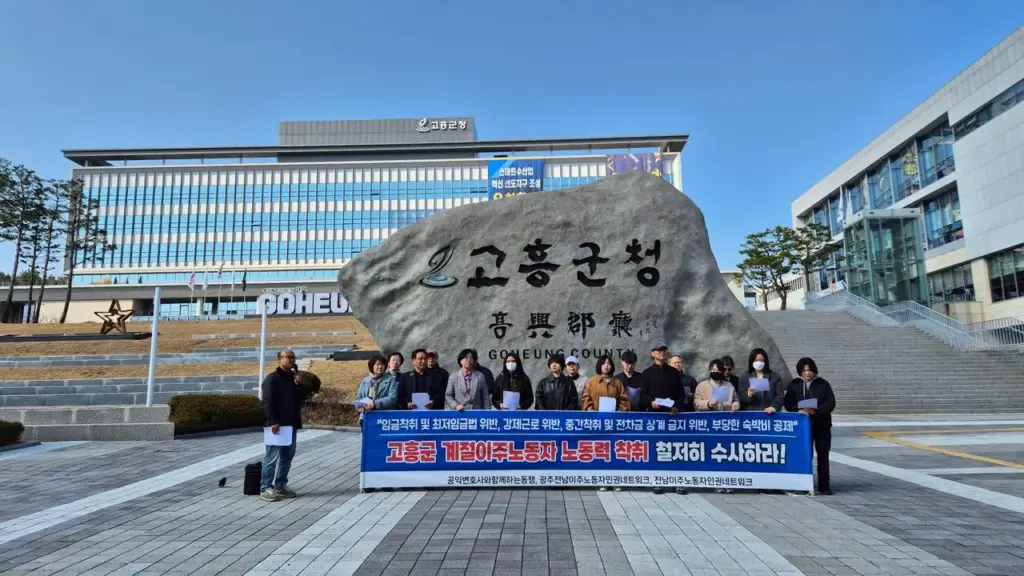
On March 10, the Goheung County Office issued a press release promising strong action against human rights violations involving foreign seasonal workers. They claimed they had “separated” 38 Filipino season workers from brokers who had tried to forcibly deport them. Just days earlier, a local rights group held a press conference demanding an investigation into the exploitation of seasonal workers.
At the centre of the story is a man named Han, who resides in the Philippines and claims to be a “Seasonal Worker Coordinator” responsible for the selection, paperwork, and training of Filipino seasonal workers destined for South Korea.
According to a letter from the Filipino regional authorities and seen by SisaIN, Han was also responsible for wage management, immigration control, and interpretation services.
But this letter is not valid in South Korea – in fact, the country prohibits anyone other than the state, local governments or specialised labour agencies from intervening in the seasonal workers program.
According to the report, the Jeonnam Migrant Workers’ Human Rights Network revealed in February that workers under Han’s “management” received less than 10 per cent of the hourly minimum wage. He’s also accused of forcing 15 women to live together in a dilapidated house under constant CCTV monitoring. Other workers saw their first month’s salary completely wiped out by Han’s upfront deductions for housing, food, airfare, and drug tests. Han says he feels “wronged” and “frustrated” by the accusations. He maintains that he paid upfront for things that should have been paid for by the local authorities, and then deducted the expenses from the workers’ first month’s salary.
The article underscores the administrative negligence that enables this abuse to take place. While Goheung brought in about 1,000 foreign seasonal workers last year, the county office employed only two officials to manage them. This creates the conditions for human rights abuses, including trafficking by laying the groundwork for illegal brokers like Han to step in. SisaIN also reveals that workers who were supposedly “separated” from their abusive brokers have continued working in the same place, and that many are forced to seek medical care under their employers’ names due to a lack of health insurance.
Government interventions have so far been ineffective.
In January, the Ministry of Justice introduced a new policy to designate private corporations or organisations as “Specialised Seasonal Work Agencies” in an attempt to stop illegal brokers. But critics warn this profit-driven system is backfiring because it effectively legalises brokers en masse, which could potentially worsen human trafficking and other labour abuses.
The article concludes with Ko Gi-bok, a representative of the Migrant Human Rights and Culture Center for All, arguing that the central government must step in and provide direct support to foreign seasonal workers and their employers through various government ministries.
“Migrant labour policy is fundamentally labour policy. This problem arises because the Ministry of Justice is attempting to take charge of labour policy beyond visa issuance,” he said.
The stakes are no longer just domestic. The article notes that US president Donald Trump signed an executive order earlier this year to review forced labour in overseas seafood supply chains. According to an anonymous expert on migrant workers: “If the seasonal worker system is operated in a manner akin to human trafficking, it will cause problems in trade with the United States as well.”
The original article ‘계절근로자 ‘브로커’ 키우는 대한민국’ by Jun Dahyeon was first published in Korean by SisaIN on April 22, 2026.
SisaIN is a prominent South Korean current affairs magazine known for its investigative reporting.