An ecofeminist journalist argues for a radical redistribution of resources in our petro-dependent world – and the enabling role of journalism
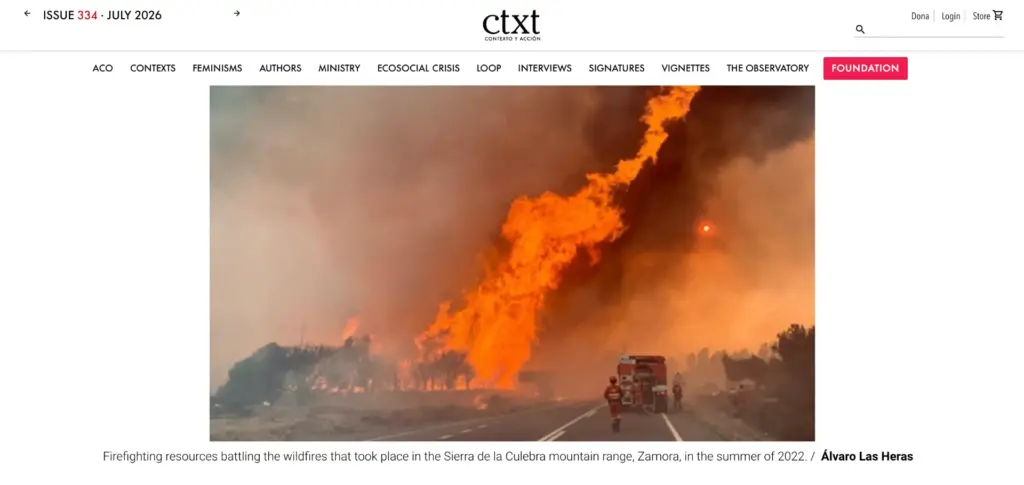
Our world is melting. During this summer’s ongoing heatwaves, cities like Guadalajara, León and Sicily are burning. Concrete slabs on German motorways are buckling under the sun. Several nuclear power plants in France have shut down. In Tunisia, 48°C led to blackouts that disproportionately affected poor neighbourhoods, disrupting hospitals, desalination plants and practically every sphere of everyday life. Everything that sustains life on our planet is under threat, warns ecofeminist journalist Yayo Herrero in a recent letter to donors for the Spanish magazine Contexto y Acción.
This is a direct consequence of “sacrilizing fossil fuel capitalism”, she writes.
Worldwide, most households have no air conditioning – the same is true for public buildings and transportation services. This year, thousands of people have already died from extreme heat and thousands more are being displaced by historic wildfires. In the face of the climate emergency, Herrero writes, we need to seriously transform the relationship between us, the economy and the land – and we must start in places like Europe where the privileges we’ve enjoyed from centuries of extraction are most pronounced.
To illustrate her point that material scarcity is linked to irrational economic practices, Herrero highlights how global oil shortages are affecting people and businesses in South Asia, where localised stories on this subject often go amiss. She cites people panic-buying rubbish bags in South Korea and rice producers predicting price increases due to shortages of vacuum-sealed packaging – both of which are derived from petroleum byproducts. She also looks to Malaysia, where manufacturers warn that a shortage of rubber latex is threatening the global supply of medical gloves. And in India, disruptions to condom production are planned due to difficulties obtaining silicone oil and ammonia, a vital nutrient also for agricultural crops.
Without a radical redistribution of resources in our petro-dependent world, Herrero writes, “eco-fascism” will be sustained by the logic of “green capitalism.” It’s not about just reducing CO2 emissions or improving industrial processes. Instead, we must radically transform systems of production and reorganise life in order to meet everyone’s basic needs. She admits that she doesn’t know of any political proposals working in this direction – but says that even an imperfect solution could help hinder the most violent abuse of our planet.
This entails new ways of producing food and generating renewable energy but also land-use planning and ecosocial education, led by the people and for the people.
She concludes on a hopeful note: journalism has the power to push for change. After all, she writes, the verb “to melt” has another meaning: to soften or dissolve with love. “In a world that is melting, journalism, like politics, must be a form of fierce, truthful, and rigorous love, essential to transforming every zone of sacrifice into a zone of re-existence.”

The original article ‘En un mundo que se derrite’ was first published in Spanish by Yayo Herrero in CTXT on July 27, 2026.
CTXT (Contexto y Acción) is an independent, left-wing Spanish online magazine that publishes in-depth reporting and political commentary, with a focus on social justice and the climate crisis.
Summary by Isa Jacobs