Abbas Asaria unpacks Spanish reporting on Madrid’s worsening housing crisis – and the unlikely culprit driving evictions in the name of charity
Madrid is one of many European cities facing a worsening housing crisis. Madrileños, as we locals are known, are grappling with soaring housing costs in part due to illegal short-term tourist rentals and the selling off of public housing to private equity funds. This spring, thousands of protestors in several Spanish cities including Madrid, Málaga and Cádiz, took to the streets to decry this trend.
But while private investment funds and landlords are known to prey on vulnerable tenants in Spain and elsewhere, there is another party driving evictions across the Spanish capital: the Catholic Church. While seemingly an unexpected culprit, the Church actually has a long history of earning revenue from property. A Guardian investigation from 2013 revealed how The Vatican amassed a secret international real estate portfolio worth more than £500 million (about US$676 million) using money from the former Italian fascist leader Mussolini.
In a piece for El Salto, journalist Alejandra Mateo Fano reveals the extent of the Church’s real estate portfolio in Madrid, and how they mirror the neoliberal practices of other private property owners at the expense of hundreds of Spanish residents. The fact that it contributes to funding their missions may well continue to justify such profiteering, despite the moral contradictions of the impact on their tenants’ welfare.
Three of the six cases described in this piece are particularly compelling because they demonstrate how some of Spain’s religious organisations have been complicit in rentierism with properties donated by their followers: both through forced evictions and selling properties to investment funds. The first case is that of 67-year-old Mariano Ordaz. As Mateo Fano writes:
He was evicted from his apartment where he’d lived all his life in Madrid’s Embajadores neighbourhood by the Venerable Third Order of St. Francis of Asissi (VOT). This religious order refused to negotiate an accessible rent with the pensioner despite owning over 300 properties in the centre of Madrid, the majority of which were donated by their followers to support The Church’s philanthropic work. The truth, however, is that cases like these have been quietly happening over the years while these orders have been making a show of values such as charity, helping one another, and hospitality. The Church relentlessly orders these evictions, despite the fact that many such tenants were able to prove their vulnerable status.
Mariano, who had to move to a hostel after his eviction in May, isn’t the only tenant facing abusive practices at the hands of the VOT. But residents have started to take matters into their own hands. The Afectados por los Curas (“Victims of the Bishops”) is a movement that started in the wake of Mariano’s eviction to help other affected tenants organise against the VOT. Working alongside the Madrid Tenants Union, the movement includes over 40 other tenants facing deteriorated housing and extortionate rent increases.
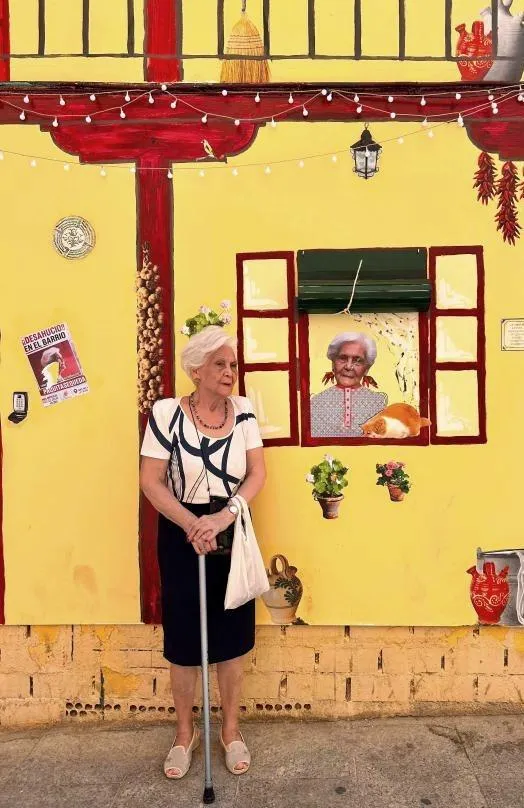
Neighbourhood associations also work alongside the union to provide resources and support to tenants in public and private housing, where the options for recourse are clearer, albeit limited. Among the beneficiaries of this action are older and vulnerable tenants like Paquita, an 82-year-old pensioner with Parkinson’s, who faces eviction from her flat in the La Latina neighbourhood. Her corporate landlord, who illegally operates 21 short-term tourist rentals in the same building, plans to do the same with her home. The local neighbourhood association, AV La Chispera, helped to delay her eviction by organising protests and publicising her case, though it’s unclear when she will be forced to move.
Such cases are especially egregious given the tax incentives benefitting religious organisations in Spain. In addition to receiving over €150,000 (slightly over US$175,000) in government grants over the last two years, VOT also receives sizeable tax deductions on donations. And as the El Salto article explains in a second case regarding evictions from a building in Madrid’s Tetuan neighbourhood, many devotees are misled into believing that their properties will be used for good causes upon their death:
Websites of organisations like the The Hospitallers Order of Saint John of God (The OH) urge their followers to bequeath their properties when writing their last wills, via what’s known as charitable legacies. In the case of the OH, they insist that the properties will be used to “create a future with better opportunities for those who most need it, and therefore a more just world for everyone.” Although they start by saying that the legacies will be used for social good, they later state that the order “reserves the authority to determine that another purpose might require priority attention [for them].”
One such example took place a number of years ago, specifically in 2020 in the height of the pandemic. A devotee, who rented the properties in her building in Madrid’s Tetuan neighbourhood at accessible prices, donated the property which housed the environmental cooperative Ecosol to The OH via a charitable legacy. Despite identifying itself as a “non-profit, religious organisation”, they sold the building to an investment fund via a real-estate company, Apolo Real State S.L. Soon after, it was acquired by the real estate find Élix Rental […] which evicted all of the tenants in one go via a court order.
The third and final case, described as “The Church’s greatest real estate scandal in Spain” by the newspaper El Confidencial, has been ongoing since 2019. It relates to the Fusara Foundation, an organisation linked to the Archdiocese of Madrid, whose mission is to educate underprivileged children. They were bequeathed 14 buildings in 1922 by two widowed devotees to house “the poor of Madrid”. Instead, the buildings were sold to a shell company called Tapiamar Partners.
Mónica Sevil, one of 200 residents now facing possible eviction from Tapiamar, is also acting as a lawyer in the ongoing court case. Irregularities in the sale allowed the residents to contest it as illegal; in October 2019, they filed a complaint in Spain’s Magistrates Court alleging fraud, corruption and mismanagement. The judge opened proceedings in March 2020 and then suspended the sale as a precautionary measure, she told the newspaper Público. But according to the El Salto article, this didn’t prevent Tapiamar from trying to expel the residents in the meantime.
An internal investigation by the Archdiocese determined that the sale of the 14 buildings and reinvestment of the proceeds was part of a scheme among those involved in the sale to defraud the foundation, generating a multi-million euro loss in the process. Fusara subsequently joined the legal case as direct victims of the charges against those parties: members of the Archbishop’s administration at the time of the sale, Tapiamar, and the intermediaries who profited from those operations.
Last year, however, Fusara reached an out-of-court settlement with Tapiamar: Fusara would receive an extra €25 million (about US$29 million) for the sale and recover one of the 14 buildings. According to a press release on the Archdiocese’s website, this was to “guarantee the continued existence of their children’s schools and homes” and “protect the foundation’s mission: the care and education of underprivileged children”. Meanwhile, residents of the buildings have since been expelled from the case against Tapiamar under a Spanish doctrine which requires charges be filed by either a direct victim or the public prosecutor. They’re currently appealing this decision in Spain’s Constitutional Court, but have already started to receive letters from Tapiamar saying their rent contracts would not be renewed.
With few avenues left for legal recourse in Spain, Mateo Fano notes how tenants have reached out to Pope Leo XIV for help. During the pope’s visit to Madrid in June, in which he spoke about social justice and income inequality, a spokesperson from Spain’s left block handed him a letter signed by the tenants and the Madrid Tenants Union. The letter details their suffering, highlights how the properties in question were donated for social good and asks for his intervention.
But action seems unlikely. While the Vatican sent a lawyer to help with the Archdiocese’s internal investigation, the letter has yet to receive an official acknowledgement or response.
For what it’s worth, as Mateo Fano points out, there is some criticism of religious rentierism from within the Church. She quotes Pepa Torres, an activist from Revuelta de Mujeres en La Iglesia (“Women’s Revolt Within The Church”), one of Spain’s Basic Ecclesiastic Communities – a grassroots faith organisation focussed on social justice:
“The Church’s social doctrine determines that the social function of property should take precedence over private ownership,” and as such, “Policies that look to privatise goods such as property should be challenged by those who believe in the Gospel.“
Amidst the numerous housing sales originally destined for social causes, they call for the right to universal public housing from a political as opposed to a welfare-based system. “It’s a wasted opportunity that Pope Leo XIV neglected to meet with any grassroots or civil society movements that campaign for the right to housing,” Torres concludes.
Meanwhile, there is a bigger, more urgent question at heart of all of this. As the tenants wrote in their letter: “How can the Church, which is called to be a refuge and defender of the vulnerable, take part in decisions that place people’s housing security at risk solely for economic gain?”
It’s a question we’d all like an answer for.
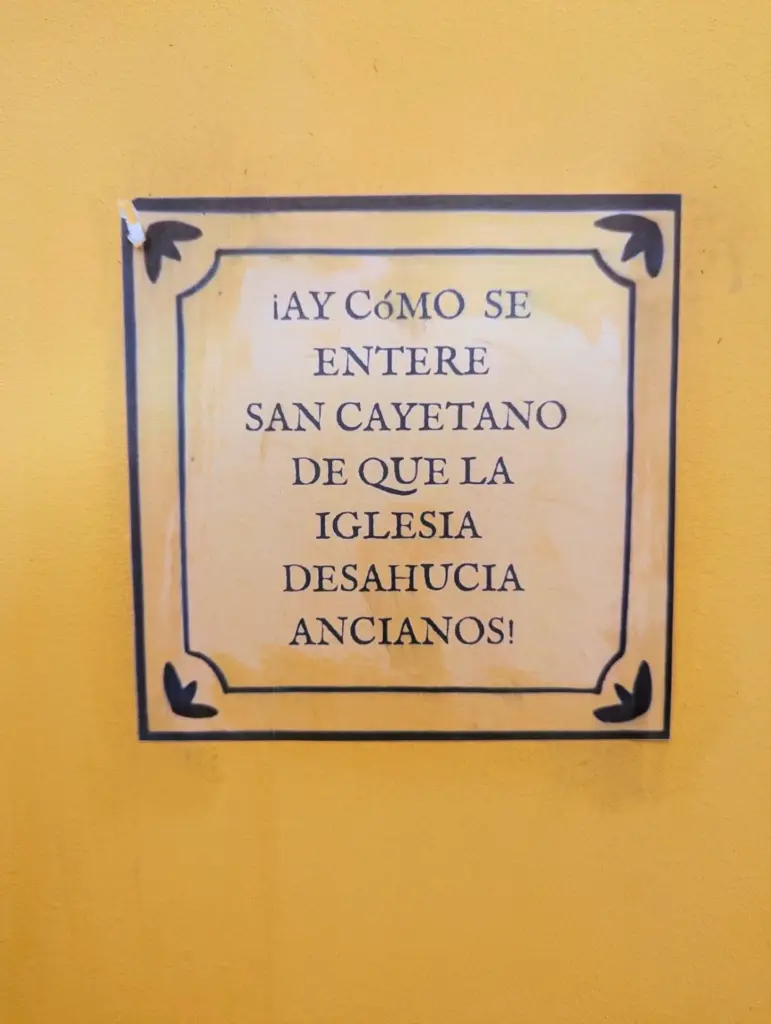
Featured image: A plaque, featured as part of the same mural of Paquita above, reads: “Oh, if only Saint Cayetano were to find out that The Church is evicting the elderly!” Credit: Abbas Asaria
Update October 2, 2026:
The housing crisis in Madrid reached a breaking point in late September, following the eviction of 87-year-old Maricarmen Abascal from her long-time home. Protests erupted across the country in solidarity with Maricarmen, prompting the real estate company to back down and restore her old rent. Pope Leo spoke out about her eviction, asking: “What is the problem in the system, that allows a partly disabled elderly lady to be thrown out of her house by the police? … We need to pressure political leaders to seek a solution to this.” As of October 2, he had yet to acknowledge or respond to the letter from the Madrid Tenants Union.