How the disappearance of waiting rooms in Italy’s train stations is the latest symptom of the country’s neoliberal turn
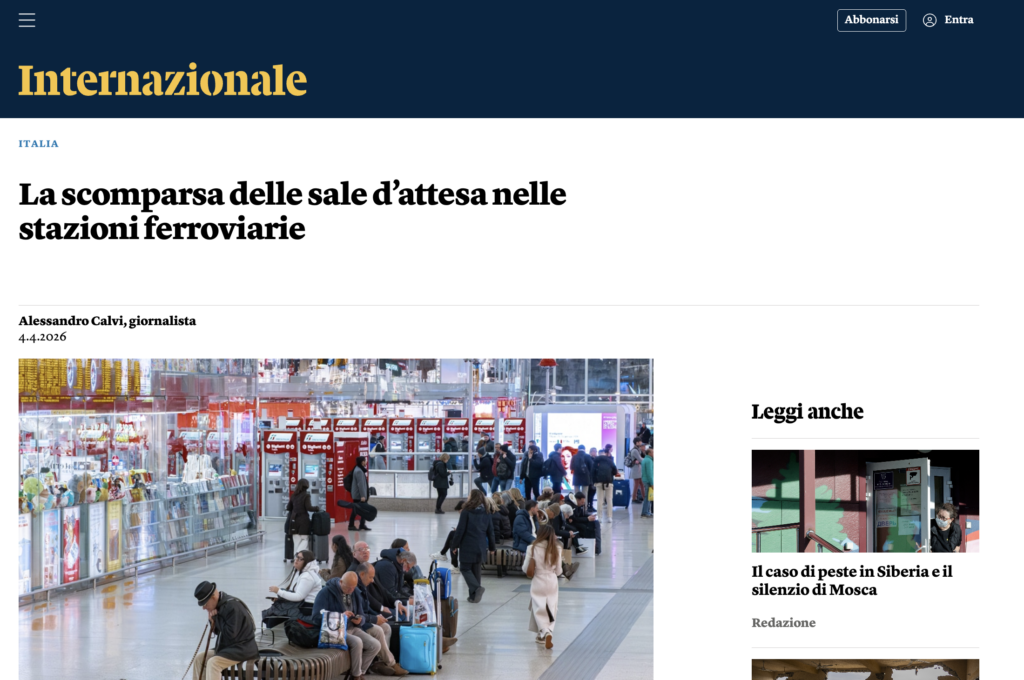
There was a time not too long ago when Italian train stations were spaces designed for killing time. Mostly built in 1930s rationalist style to highlight their monumentality and civic function, they were first and foremost public spaces. Today, these monuments of modernity have been taken over by retail shops, private passenger lounges and military personnel patrolling their scenic corridors.
It would be easy to ascribe this change to a shift in mores—after all, what’s the point of a waiting room if most people now show up just a few minutes before the train departs? Likewise, what’s the use of a ticket office when you can buy online? But as Alessandro Calvi writes in a perceptive opinion piece for the Italian weekly Internazionale, the disappearance of waiting rooms and benches inside train stations is a symptom of a larger phenomenon whereby public spaces are being turned into cathedrals of consumption.
He starts by relaying an episode he witnessed at Roma Termini, when a husband turned to his wife on vacation and exclaimed, “we are in Rome!” But the view of one of the country’s most iconic examples of modernist public architecture was obstructed by a military vehicle parked outside – its presence part of a government strategy to reclaim “vital spaces from illegal activity, social marginalisation and urban decay.” Calvi writes that Bologna is now the only major Italian city with a train station waiting room, and that’s partly because it commemorates the 1980 terrorist bombing, in which 85 people were killed.
Calvi explains how the disappearance of waiting rooms dates back to the period of privatisation in the early 2000s when Italy’s national railway company was split into various for-profit entities. Consequently, these “dead” spaces needed to be put to use. The long corridors and hallways which gave Italian train stations much of their character were covered up with retail shop fronts. Killing time became a luxury for the privileged few who could afford to pay for passenger lounges.
He also tackles the other side of this “regeneration” phenomenon, by travelling to small towns where neglected local train stations now operate largely as bus stops. Matera, once the European Capital of Culture in 2019, has been waiting for more than 30 years for expanded railway connections. It is still connected to Potenza, another major city in the Basilicata region, by a replacement bus service. Calvi writes that these train stations, which are seen as unprofitable, will inevitably fall by the wayside.
Calvi ends his opinion piece by arguing that Italian prime minister Giorgia Meloni’s security crackdown on crime and deviance, what he terms svolta securitaria, is the latest phase of the neoliberal mutation of the early 2000s. The soldiers patrolling train station corridors lined with luxury brands and fancy coffee shops are there to ensure nothing disrupts the smooth running of mindless consumption.

Summarised by contributing editor Bartolomeo Sala
| Bartolomeo’s take: By far, one of the saddest effects of neoliberalism in my view is its deracination of the urban fabric. I think of this often as an Italian living and working in the UK. (There is nothing depressing to me about walking into a mid-size market town and seeing that high street has been take-over by private equity-owned chains). In analysing the disappearance of train station waiting rooms as part of a larger phenomenon of neoliberal expansion in Italy (and throughout Europe) today, Calvi shows how this all-encompassing way of organizing society persists even in seemingly mundane ways. It has left me wondering how people would make use of public spaces if they weren’t always under such pressure to consume. |
Original by Alessandro Calvi ‘La scomparsa delle sale d’attesa nelle stazioni ferroviarie‘ was first published in Italian for Internazionale on April 4, 2026.
Internazionale is an Italian weekly magazine which curates and translates the best journalism from the global press into Italian.