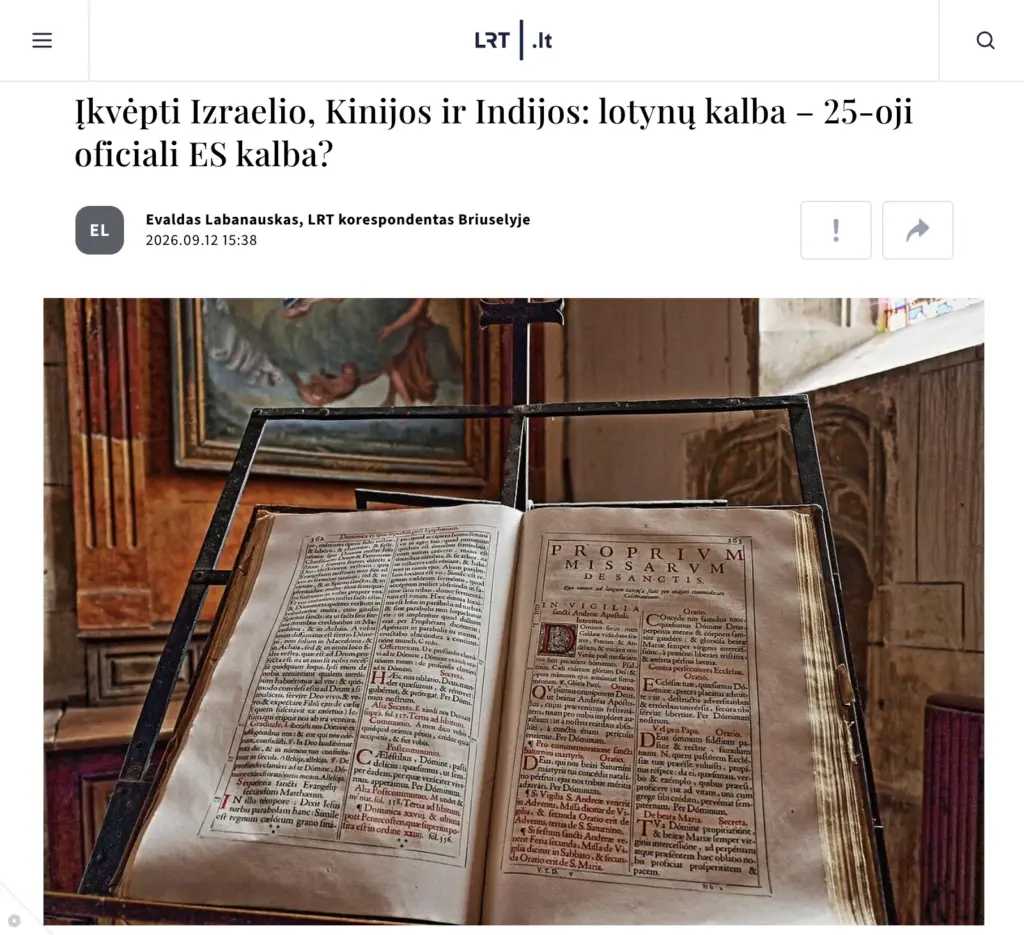
The EU currently has 24 official languages. Lithuania’s national broadcaster LRT reports on a group of young Europeans who want to add a dead one
Timi Celcer, who considers himself “pan-European”, returned from a four-month backpacking trip around the world thinking about how other cultures relate to their past. He was struck in particular by India and China, which stay closely tied to their traditions, while many Europeans seemed to be drifting from theirs. Europe, Celcer concluded, was missing a third “pillar of integration” alongside the political and economic ones: a cultural one. He realised that Latin once fulfilled that role, and could do so again.
Via Nova, Latin for “new road”, is the small NGO that Celcer now leads. Its founders, who come from France and Slovenia, aim to establish a membership drawn from all over Europe. This includes Lithuania, where, Celcer points out, they have not found supporters yet. The article for LRT outlines Via Nova’s vision of a four-stage, multigenerational process: winning public support, bringing Latin into everyday culture, expanding its institutional presence and eventually securing official EU recognition without displacing national languages.
A new lingua franca to unite a divided Europe… Does that ring a bell? The founders dismiss comparisons with Esperanto – a confected language developed around the end of the nineteenth century by Polish-Jewish opthalmologist Ludwik Zamenhof – arguing that Latin has one key advantage: it wasn’t invented. Once a working language of European academics, diplomats and the clergy until the 18th century, Latin still carries symbolic weight across Europe. Celcer sees English as too broad and too tied to American influence to unite Europe. Language, he says, is “the most powerful symbol of belonging to Europe”, and Latin is anchored to no single country.
Recognising that widespread adoption and EU recognition could take entire generations, Via Nova envisions a gradual process of building public support. The founders trust that Latin lingers in Europe’s collective cultural memory, strengthening their faith in the project. In particular, Celcer recalls a 1979 European Parliament exchange in Latin between left-wing MEP Mario Capanna and head of the Pan-European Union Otto von Habsburg, who praised the language as “truly European”. Via Nova co-founder Gašper Valentin Mlakar notes that new European organisations still often give themselves Latin names.
As for the ambitious task of learning Latin en masse, it’s not as hard as it might seem, points out co-founder Pierre Gorsky-Mieze. He estimates that learners could reach CEFR B2 proficiency (the upper intermediate level of the Common European Framework of References for Languages) in as little as two years, with two hours of weekly study alongside regular conversation. Most of the founders are still learning too, Celcer clarifies.
But none of it, co-founder Tilen Božič stresses, is about dragging the past into the present. The road they are building, after all, is a new one.

Summarised by Gerda Krivaite
| Gerda’s take: Lithuania knows what it means to have its language pushed aside. Under the Russian tsars, printing Lithuanian in the Latin alphabet was actively banned for 40 years, with renowned ‘book smugglers’ carrying banned books across the border. Language remains heavily political to this day. As the Baltic country moves away from Russian in schools, the share of Lithuanian sixth-graders choosing Russian as a second foreign language has fallen from 76% to 44% in the space of three years. Here, a story about language as a shared European symbol strikes a nerve. It also raises broader questions for all of Europe – the whole continent still heavily relies on English, and we have yet to settle on a better alternative. |
Original by Evaldas Labanauskas, ‘Įkvėpti Izraelio, Kinijos ir Indijos: lotynų kalba – 25-oji oficiali ES kalba?’ published in Lithuanian by LRT on September 12, 2026.
Lithuanian National Radio and Television (LRT) is the publicly owned national broadcaster of Lithuania.