How Super El Nino is changing the livelihoods of Pakistan’s fishermen
The monsoon rains, rare these days, have failed again. A persistent drought and a quiet unhappiness hang over the Indus Delta in southern Pakistan. This year, the lack of rain and upstream diversions mean the water in the creeks turns salty far earlier than usual. October arrives unseasonably warm, as the ‘Super’ El Niño expands its reach over the Arabian Sea.
One day, my friend Nazar and I reach Kharochan Jetty, where the Indus finally meets the sea. Our tappal boat is waiting to carry fish back from the ghatus.
 ٽپال  (tappal): Sindhi for "mail" or "post"; in another life, this little boat would have carried letters instead of snails. Here, it ferries the day's catch between the fishing boats and the shore.

گهاتو (ghatu): A fisherman, or one who goes out for fishing. In the delta, ghatu are mostly trapped in debt and are therefore unable to live freely.
The engine catches with a shudder through the whole hull, and we cross Khobar Creek, one of the 17 mouths of the Indus. The boat rocks hard in the chop until a second engine steadies us. I lick the salty creek water off my hand. Thirty minutes on, we reach Kharochan, once a sizeable town, now a line of sea-ravaged huts and boats.
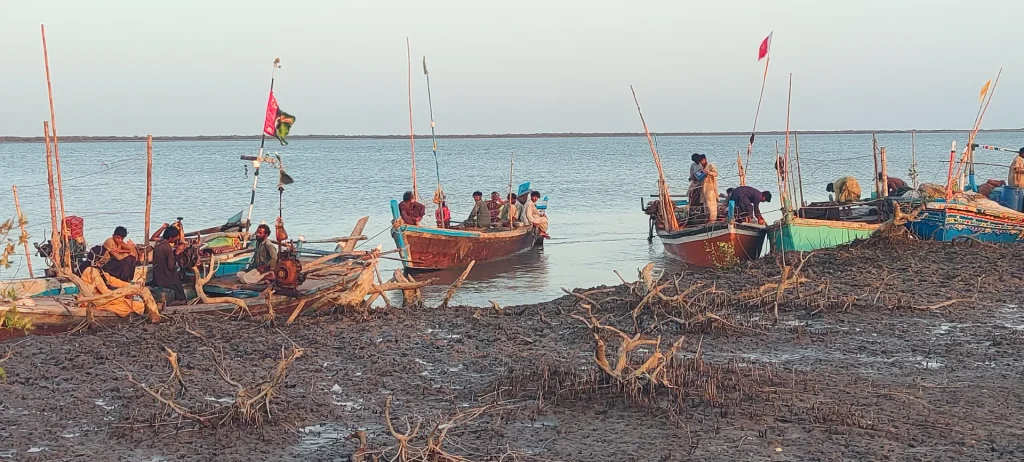
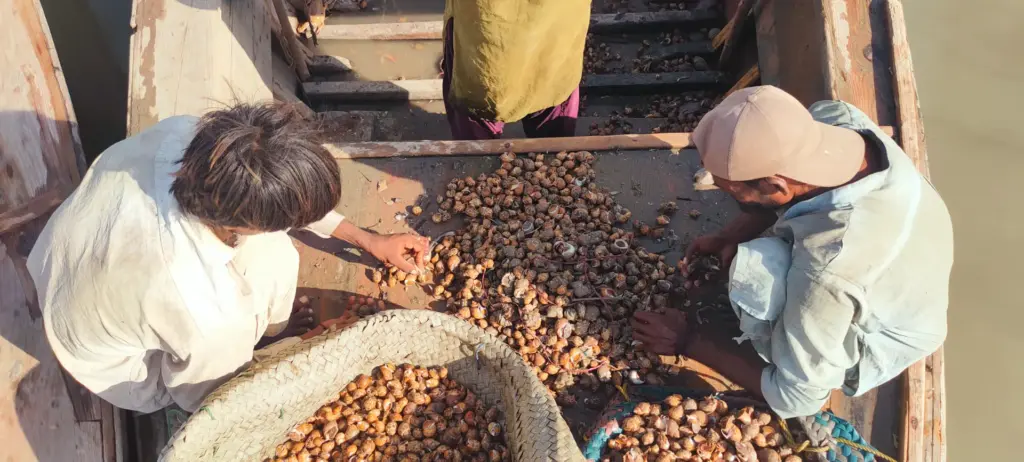
We sail further into Sanrhi Creek. The mangroves here should be sacred nurseries, with roots thick enough to shelter fish, birds and animals – but there are too few, and none of them have grown tall. Birds lift off ahead of the boat. By evening we reach Aadyarhi Creek, where fishermen are already waiting for the tappal. Two men are sorting a catch kodi, or kodyu, to be shipped abroad to China, Singapore and Thailand, where they will be served as a delicacy. One of the men, Ali Nawaz Mallah, carries something sad in his pale face.
ڪوڏيون (kodyu, kodi - singular): The Sindhi word for sea snail (Babylonia spirata in Latin). Munshi, one of our crew, tells Ali Nawaz he’s brought diesel and gutko. One of the fishermen asks about ‘sweet water‘.
گٽڪو (gutko): Chewing tobacco and areca-nut mix

mitho-panri, or 'sweet water', means drinking water, typically brought on board in 40 litre blue cans.
“Next time,” Munshi says. The catch is thin, the heat too strong, the snails dying in the sacks. Unhappy with their meagre catch, Munshi decides we will stay the night rather than turn back.=
The fishermen often spend months living in makeshift tents on the mudflats, wading through silt at low tide, watching for snakes, and timing their work against the return of the water. Winter is the best season for the catch; they’ll throw their nets until the sea gets harsh again in summer. As evening comes, our boat anchors near the bank. We go ashore with Munshi and his friend, past the same thin mangrove stands and the suhanrh – another rare sighting along this coast. They come back from another boat with fish for us. “What will people say — you came into the kharo (salty) waters and didn’t eat its fish?” they tease.
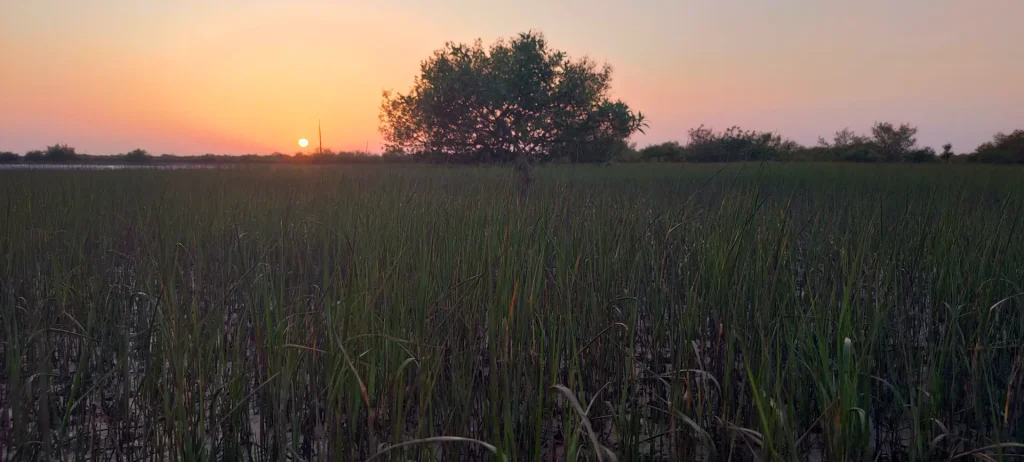
سونهڻ (suhanrh): A grass that grows in the delta, enjoyed by cows and buffalos, but that is becoming rarer. When Shah Latif, a celebrated Sindh poet, first tasted it in the 17th century, he wrote that it tasted sweet even among salty water. We sleep on the larger boat belonging to Munshi’s friend. The sky is clear enough to watch the stars. The boat rocks against the shoreline all night, its dim lights flickering. Sleep doesn’t come easily.
The fishermen are generous hosts living a hard and risky life, with no clinic and no emergency help for hours. As the tide pulls the water back toward the sea, one man cleans fish, another starts the fire; they’ll live on this boat another seven days, catching kodyu.
The Indus has been diverted for irrigation upstream for decades – what’s left is meant to hold back the sea and sustain the ecosystem. It is regulated by a guaranteed minimum release at the Kotri Barrage, the last barrage before the delta. But various independent environmental studies say this threshold isn’t being met. With less fresh water being pushed out, the sea is pushing in.
Nakho, the captain, says these diversions have put them in trouble. Nazar adds: “The Indus is held back in the dams and the farms upstream, and that’s why the sea keeps taking their land.”
By morning, around 5 a.m, someone is already up making tea. The others start folding blankets, getting ready with the nets.
By the time we leave for the sea, it’s rough again. The ghatus go to work: one man pulls the net out by hand, another clears fish from the cage, two more pack dead fish with salt to use as bait, and one sets the lines. Today, the catch is good.
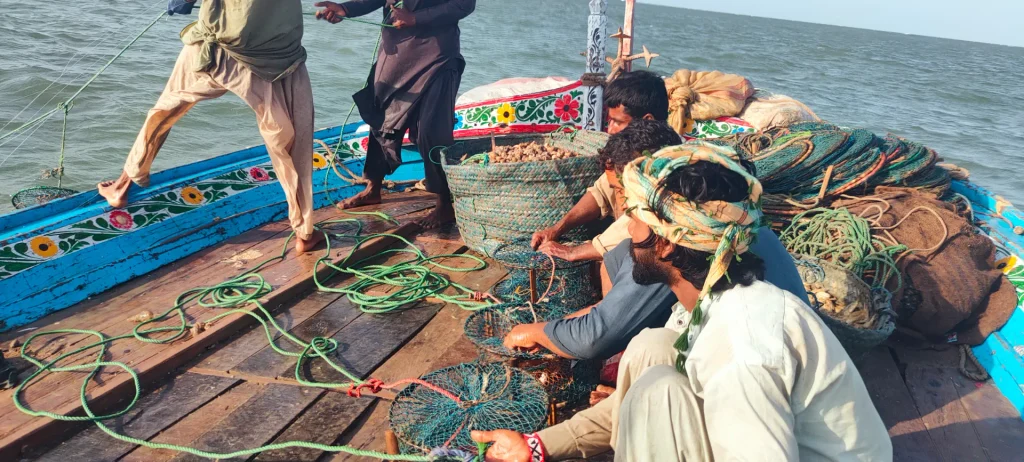
We stay out until the early afternoon. The sea smell gets caught in our noses, causing dizziness, then vomiting. I remember a fisherman once telling me to eat bughra which helps. There is no shade out here, and the sun is cruel.
bughra: dried peasWith the nets in and the next catch set, we head back to the bank, where Nakho and Munshi are already waiting to collect our catch. We call out wari milandasi and leave, but not before saying goodbye to Ali Nawaz.
وري ملنداسين (Wari milandasi): A goodbye that assumes you'll meet again.On the boat, I see a man lying on the deck under the full sun, while the others sort their catch. “What happened to him?” Munshi asks.
“Pheri thi athas,” they say. Sea sickness has caught him. I recall my own sickness, despite having done none of his labour.
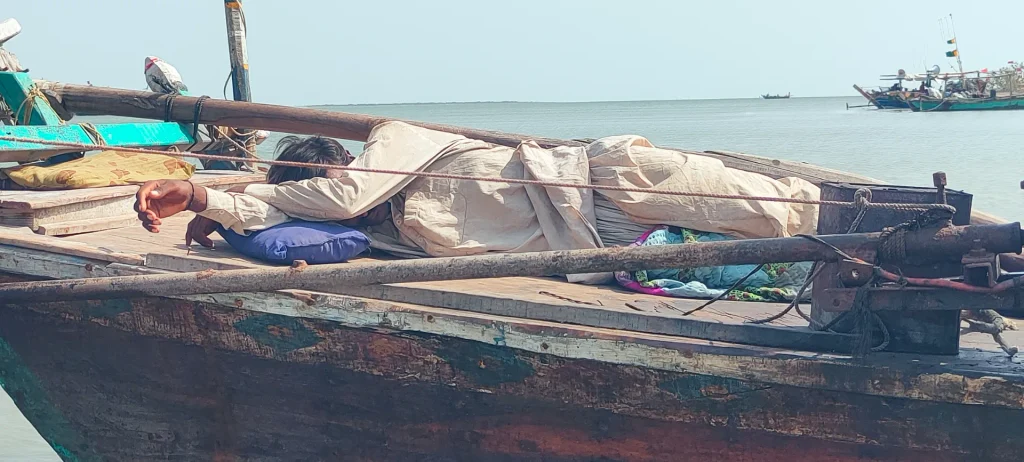
Nakho says he’ll take him back to his village to recover.
After the catch is weighed and settled, Ali Nawaz comes aboard our boat with a 40-kilogram rice sack holding his blanket and his clothes. We head back the way we came.