Publication Name: Al-Hudood
Founded: 2013
Format: Digital
Country: UK
Languages: Arabic, English

Arabic satirical website Al-Hudood has not had an easy ride.
The publication’s original three founders attempted to first register in Jordan but faced various bureaucratic hurdles and interrogations before they were ultimately ghosted by the authorities. In 2013, Palestinian-Jordanian co-founder Isam Uraiqat registered the site in the UK.
“It was so much easier than what we had to handle [in Jordan],” he tells Translator from his London home office. “Not to say that we didn’t have our own problems in Britain with our bank accounts being shut down twice, out of the blue, with no reason given.”
It was at a time when they were having “a few clashes” with foreign governments, Uraiqat explains, which is partly down to the nature of their content. He recalls two articles that caused a stir: one about Santa Claus being arrested for not paying customs on his presents, and another that compared the Jordanian national dish mansaf – a powdery dried yogurt – to a class A drug.
“We try to play it in a way where we’re upsetting them [governments and politicians] just as much as we need to and no more than that,” he says. “Because at the end of the day, we don’t want to be running a publication where people within it are fearful. It’s better us doing it rather than us not doing it because we’re in jail.”
Uraiqat, who studied film before starting Al-Hudood, says the publication was created out of the need for self-expression and to circumvent the “oppressive censorship” they faced in Jordan and throughout the region.
“If you write anything in the creative fields, it just gets butchered so, so badly beyond recognition. So me and the two founders thought we could write what we wanted to write, cover the policies that we wanted to talk about, and publish based on our decisions. So [Al-Hudood] came out of frustration and trying to find a creative and political outlet to express [ourselves].”
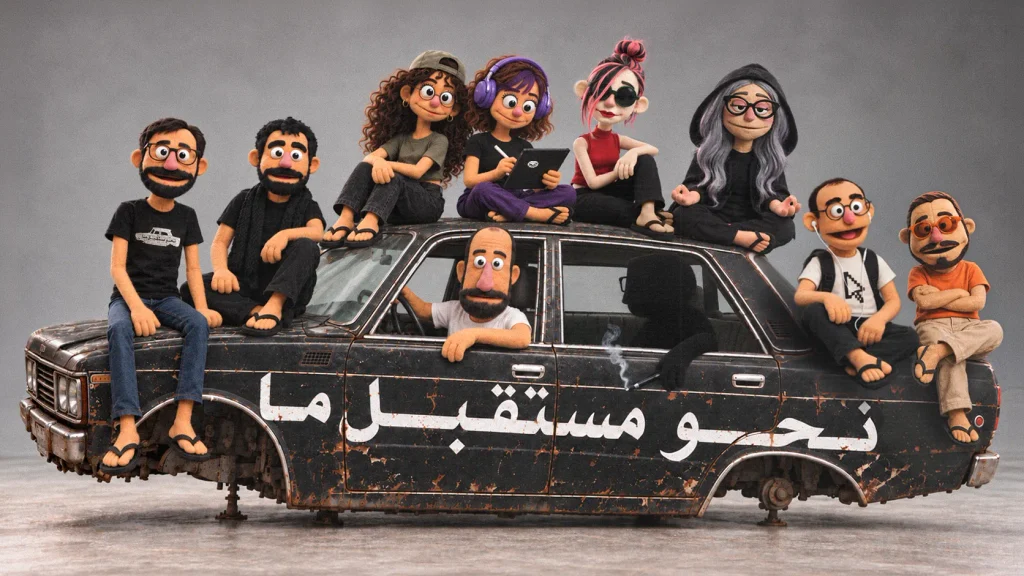
Their work paid off: on the day of the launch, Al-Hudood hit nearly 30,000 web visitors, and the site almost crashed. Today, the team is made up of 11 people based all around the world the Arab-speaking world. They are also part of the Febrayer network, which is a Berlin-based alliance of independent Arab media. Articles are written in formal Arabic, with words from specific dialects included as relevant, but no byline.
“That allows that level of insult … and makes it a lot less personal,” Uraiqat explains, adding: “The majority of our content is written in Arabic for an Arab audience, and that is a very different thing … our whole mission was always to write for us rather than for the Western gaze. We could have a much larger readership if we did, but also I think it comes at a very heavy price of us thinking in English and writing it in Arabic … you almost automatically start self-Orientalizing.”
Asked what else makes Al-Hudood different from popular English satire websites like The Onion, Uraiqat says: “Starting the joke in Arabic feels like a different thing. It took us a while to figure out how to create the language of our deadpan humour on a linguistic level. In general, it’s just a lot darker. One of our biggest challenges has always been that there isn’t enough free, independent journalism in the region. It means that you can produce a lot less jokes … it’s a whole layer that we’re building on and that layer is incredibly weak.”
According to the latest press freedom index from Reporters Without Borders, the Middle East and North Africa region is “the worst zone in the world for press freedom” based on political, legal, economic, sociocultural and safety indicators.
Still, Uraiqat says there are no subjects they won’t touch – and that includes the recent Israeli elections and the ongoing genocide in Gaza, which the outlet has covered widely in the lead up to and after October 7.
“[We have] a decent amount of articles criticizing Israel, but we’ve probably criticized Hamas more. Not because Hamas is worse in any way, but our audience knows how awful and what Israel is doing. Me finding another dark joke about that … [people] don’t give a shit. What is relevant to me could be Hamas, Hezbollah, or how Palestinians themselves are dealing with it. It is very specifically not aimed at the Western audience.”
We end our conversation with a much bigger question: what is the role of satire in the Arabic media landscape today?
Uraiqat considers this for several beats.
“I think it’s being able to be a part of a healthy ecosystem that works together,” he says. “You could envisage through satire what freedom of speech looks like, right? It’s expressing yourself with ease.”
Below are three of Uraiqat’s selections from Al-Hudood, including two Arabic pieces summarised into English.
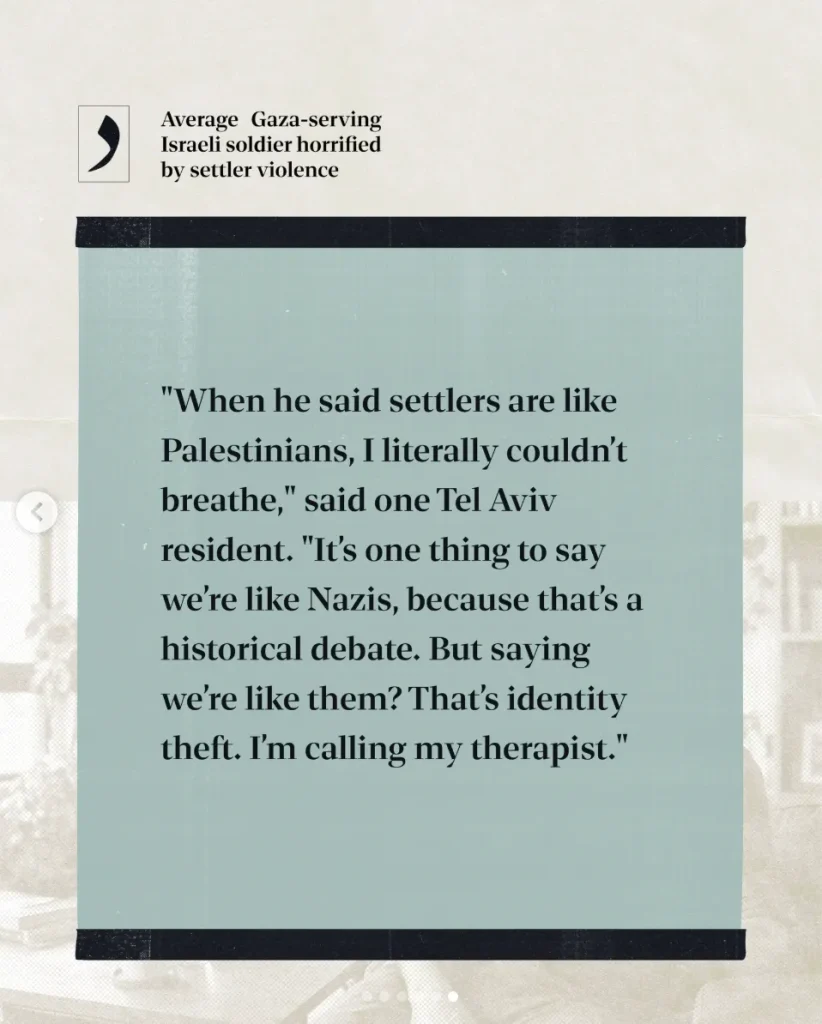
Average Gaza-serving Israeli soldier horrified by settler violence
A 21-year-old Israeli soldier who has completed his mandatory service in Gaza says settler violence horrifies him more than anything he witnessed in the IDF.
The army, he explains, is professional: commanders, F-35s, precision-guided bombs dropped from 30,000 feet, and the reassuring distance of not seeing the people being neutralised. Settlers, by contrast, use their bare hands, shout, grab things, and get blood on their clothes, behaving, he says, like the savage “Palestinians” the army is trying to remove.
The soldier insists that non-settler Israelis are normal people capable of pain, sadness and injustice, because the psychological distance of modern warfare helped them preserve their humanity, whereas witnessing settlers up close feels disturbingly dehumanising.
His remarks enrage settlers, especially when he compares their behaviour to that of Palestinians. One Tel Aviv resident says being compared to Nazis is tolerable because at least it is “a historical debate,” but being compared to Palestinians is unbearable: “That’s identity theft. I’m calling my therapist.”
This article is on the absurd attempt by the media and westerners in general to try and differentiate between what they call “settlers”, and the rest of the Israelis, who are settlers just the same but settled even more illegally, a few decades before.
Isam Uraiqat
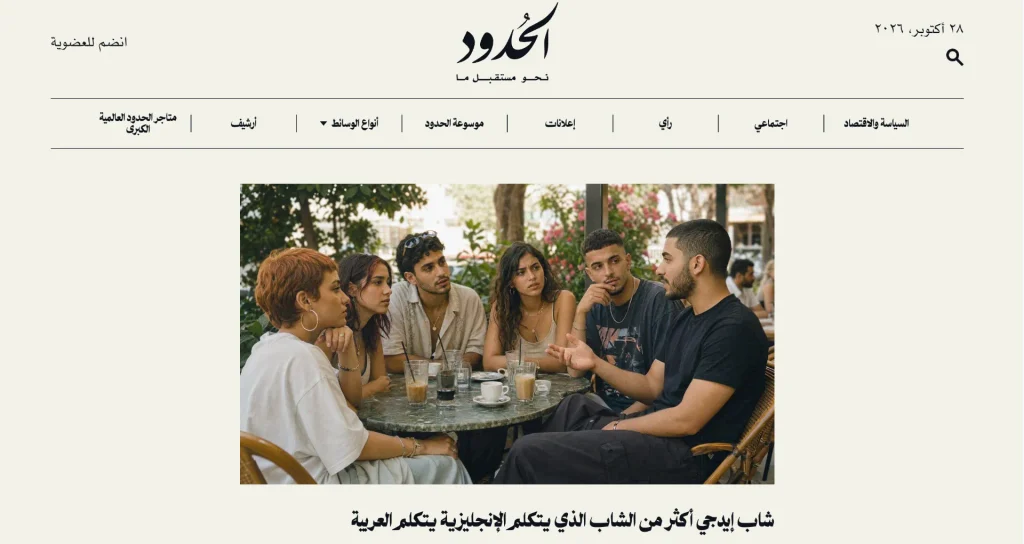
شاب إيدجي أكثر من الشاب الذي يتكلم الإنجليزية يتكلم العربية (Arab man edgier than those who speak English, speaks Arabic)
For years, English let Arab young men prove they were different from members of their families and neighbourhoods, despite all of them parking their cars on the pavements. A well-placed “literally,” “bro, it’s insane,” or “fair enough” suggested a life Arabic could never contain, and shows that the speaker has had two viewings of Fight Club, at least one without subtitles.
But English is basic now: HR staff, content creators, Dubai-returned cousins, project managers with urgent projects, even mothers saying “it’s okay” after threatening to abandon the family to live with stray dogs.
So Yaseen has retreated to the last language untouched by the mainstream: Arabic. While his friends discuss burnout, the dating scene and toxic work environments, he sets down his coffee and says, “Tamam, da3ni akhtalef ma3ak belotf fi hal-mas2aleh.”
Anyone can claim “commitment issues”; admitting “ana bakhaf aleltizam” in a crowded café takes real courage. Soon, people wonder: is he secretly writing a novel, working for the Foreign Ministry, or in a cult? They mock his “3ala ay 7al”, until they copy it, forcing him to learn hieroglyphics.
This article is on the exoticisation of the Arabic language. It started with the upper classes, but now it’s everywhere. Recently I met someone who saw me speaking Arabic to my own children they say, “Oh wow, you decided to teach them Arabic?”
Isam Uraiqat
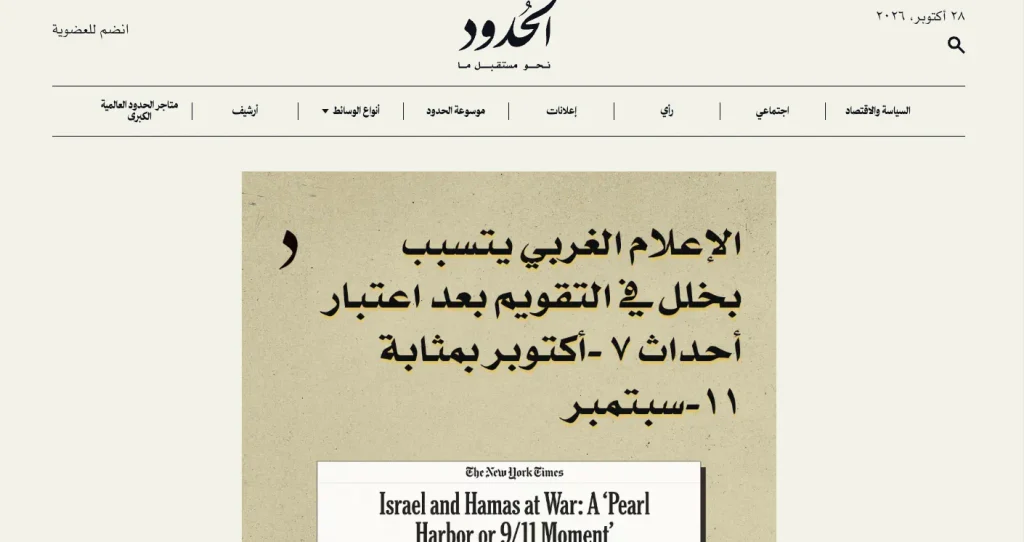
الإعلام الغربي يتسبب بخلل في التقويم بعد اعتبار أحداث ٧ -أكتوبر بمثابة ١١-سبتمبر (Western media causes calendar malfunction after October 7)
A New York Times editor woke on the morning of Sunday, October 8 and decided that yesterday, Saturday, had been September 11 for Israelis rather than October 7. Therefore today, Monday, is September 13 rather than the expected October 9. That means my October salary has not been counted, even though we are practically halfway through November.
Yet I am certain my landlord will not forgive the rent for the period during which I was asleep when the calendar changed. I will also still have to pay my electricity and internet bills or my service will be cut off; then I will argue with the officials, be arrested for assaulting a public employee, miss work, and the boss will decide to fire me and deprive me of my employment rights.
And I am not discussing the importance of this matter to me, far from it. On the contrary, it is my professional duty to highlight its repercussions for the entire world. For instance: will we celebrate President Bashar al-Assad’s birthday twice from now on? And which 11 September was he actually born on? And will Israel’s annual Ramadan bombing of Gaza take place on schedule, or a month before the holy month?
Western media felt like a farce post Oct 7, and we decided to write the article reflecting the absurdity, and to ridicule rather than to challenge the claims – as they felt beyond challenging anyway.
Isam Uraiqat