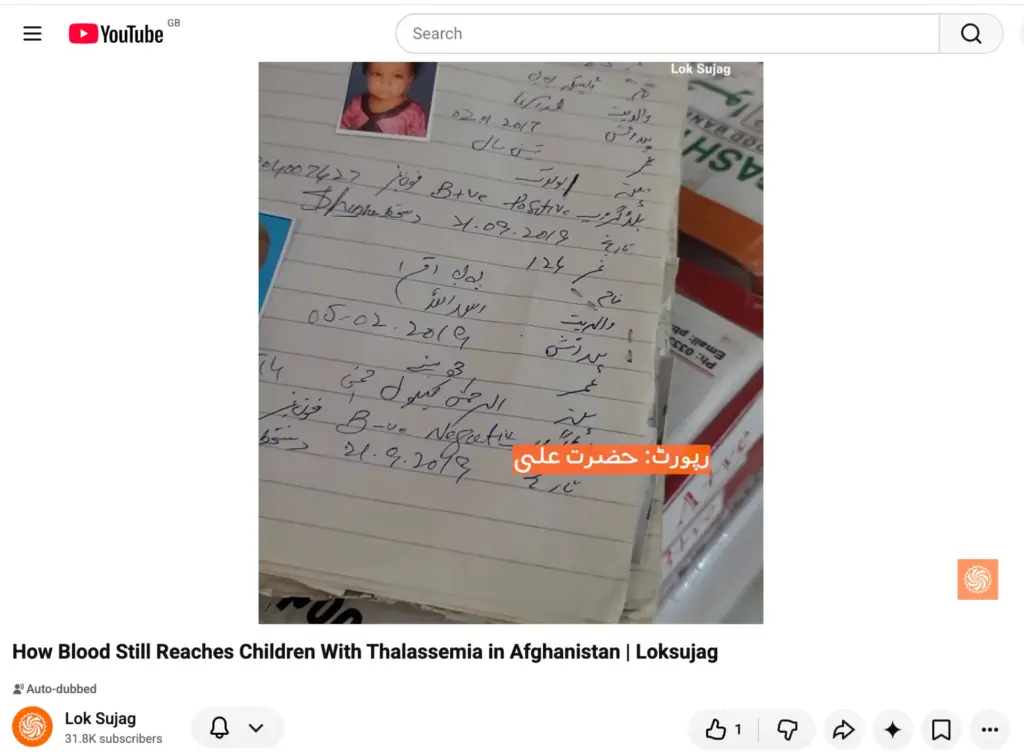
A unique, volunteer-run, cross-border transfer system is helping children with thalassemia access life-saving blood donations
In a blood bank in the Chaman district of Balochistan, Pakistan, there are stacks of files filled with photographs of children. In a video story for independent media outlet Lok Sujag, reporter Hazrat Ali Attar rifles through the files and explains, “Next to (the children’s) names, their illness – thalassemia – is noted down. And in the space for their address: Afghanistan.”
Thalassemia is a group of inherited blood disorders that diminish the body’s production of haemoglobin, leading to anaemia. The condition requires frequent blood transfusions. In Pakistan, the average lifespan for a child born with thalassemia is under 10 years. Treatment can include stem cell or bone marrow transplants, but this is a costly undertaking, and blood transfusions are commonly given every three weeks or so to manage the disease.
Pakistan has been home to Afghan nationals since the Soviet invasion of the country in the 1980s, and more recently, since the Taliban regained power in 2021. That year, up to 800,000 Afghans fled across the border to Pakistan. The children in Afghanistan that Attar reports on once lived in Pakistan but were sent across the border to live in Afghanistan in 2023, when the Pakistani government ordered the expulsion of all undocumented Afghans. The Illegal Foreigners’ Repatriation Plan came in response to a string of suicide attacks in the country – the government alleged that Afghan migrants were responsible for 14 of 24 such attacks. An estimated 2.8 million Afghans have been deported from Pakistan since 2023 – many of whom had never lived or visited there – and there are strict border closures in place.
“But these children’s bodies do not recognise any border,” Attar explains. Those who live along the Chaman-Spin Boldak border do not have consistent access to healthcare, and they cannot frequently travel to treatment centres in cities like Herat or Kabul.
Attar’s report shows how volunteers at the blood bank in Pakistan put together a package of a blood donation. “A motorcycle carries a rider and, packed in ice, this chance at a life for a child. The destination: the border at Chaman. There, the rider gives the package to some family travelling across the border to Afghanistan. The recipient’s number and address is shared, and then across the border, someone receives a WhatsApp message, ‘Don’t worry, the parcel is on the way.’”
Every Eid-ul-Azha, volunteers collect the hides of sacrificed animals, and these are sold to fund the operations of the blood bank. Clean, tested blood is provided for free. This is the only blood bank in Chaman district, and it runs on the good will of donors and volunteers.
“Blood has no passport,” Attar says. “As long as people on this side of the border keep working, a child on the other side continues to have the chance to live. But the question remains: how long can a few volunteers keep shouldering this burden?”

Summarised by contributing editor Sanam Maher
| Sanam’s take: Afghanistan has been in the news in Pakistan over the last three years with a focus on geopolitics, security and political tensions. The rhetoric against Afghan migrants in Pakistan turned hateful since 2023 – graffiti on walls in Karachi demanded that Afghans ‘go home’, and social media saw an uptick in xenophobic, anti-immigrant messages. But a story like this cuts through the noise with its focus on those people caught in an impossible situation: Afghans forcibly ‘repatriated’ to a country that they did not think of as ‘home’. This year, the Pakistan Medical and Dental Council, a national regulator, ordered that Afghan students studying medicine in Pakistan must return to their home country. Some students were sent letters giving them 24 hours to comply, creating panic and anxiety. Many of these students were young women who would not be able to pursue a medical education – or any – under the Taliban government. A legal challenge to the directive is ongoing. Stories like this one remind us of the lives affected by cruel, arbitrary policies, and how commitment to caring for one another does not recognise the enforcement of a border. |
Original ‘How Blood Still Reaches Children With Thalassemia in Afghanistan‘ first published in Urdu by Hazrat Ali Attar for Lok Sujag on October 17, 2026.
Lok Sujag is multilingual digital media platform dedicated to the voices from the margins of power in Pakistan.