A Catalan perspective on Spain’s latest train disaster
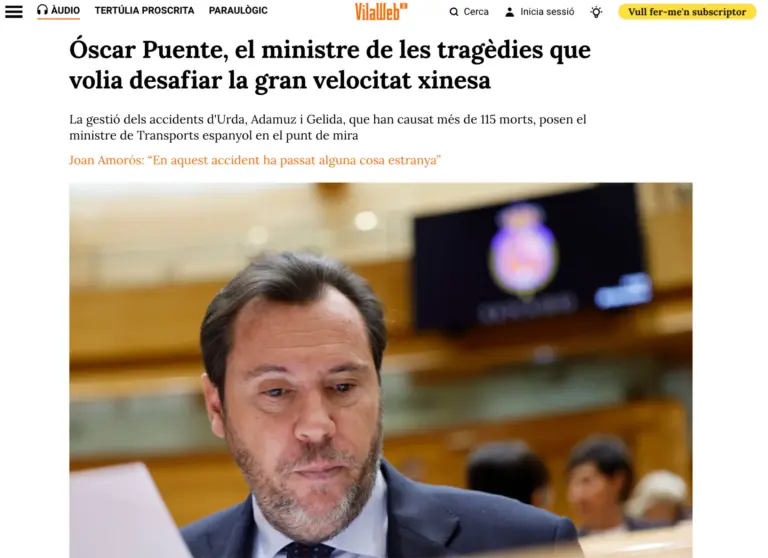
A few days before Spain’s Transport Minister Óscar Puente resigned on November 3, VilaWeb’s editorial team examined the government’s handling of three recent rail disasters, which together have claimed more than 115 lives. But VilaWeb’s story goes beyond failures on the tracks: it lays bare a deeper tension between Madrid’s centralism and Catalonia’s push for greater self-determination, which includes control over its own infrastructure.
One of the most polarising figures in Spanish politics, Puente has become the face of the national railway crisis. Some of his public responses to the disasters have been infamously cynical: “The ‘fucking Renfe’ is often not to blame for disruptions” – Renfe is the state-owned Spanish train company – was just one of his statements in the aftermath of the latest tragedy near the village of Urda, in central Spain’s Toledo province this October. His resignation followed the leak of recordings between train drivers and railway controllers, published by El Diario and Cadena SER.
But the Urda disaster was part of a pattern. Just months before, in January, a defective rail had caused a train run by the private company Iryo to derail on the same high-speed line in the environs of Adamuz, in the southern province of Andalusia. It collided with another train on Renfe’s high-speed Alvia service, killing almost 50 people. Then, two days later, another tragedy struck, this time in the autonomous state of Catalonia, in northeastern Spain. At Gelida, twenty miles west of Barcelona, a commuter train collided with a retaining wall from the motorway that had collapsed onto the tracks after heavy rain. A trainee driver was killed.
The accident triggered a major crisis in Catalonia’s Rodalies commuter network, bringing all services to a standstill. In Spain’s national Congress of Deputies in Madrid, Puente denied that Catalonia’s railway chaos had worsened on his watch, accusing pro-independence parties of “resentment” and “playing the victim”. This summer, he announced “improvements” in the form of new trains, claiming Spain’s central government in Madrid would boost capacity on electrified Rodalies lines and improve service.
Instead, VilaWeb accuses Spain’s national transport ministry of prioritising the reconstruction of the high-speed line between Valencia and Madrid: Puente called it “the best Christmas present we can offer Valencia”. Meanwhile, the long-promised Barcelona-Valencia high-speed connection remains unbuilt. First announced by the Spanish government in 1992, it is another infrastructure promise still waiting to be fulfilled in Catalonia.
Summarised by contributing editor Isabel Jacobs
| Isa’s take: The devastating crashes this year at Urda, Adamuz and Gelida exposed the crisis in Spain’s railway system and shattered the myth of its world-leading high-speed network. Public transport should be a right, not a political game, yet many people in the country see Spain’s crumbling rail network as a symbol of political failure. VilaWeb’s piece feels particularly relevant ahead of Spain’s upcoming general election this month, where the Catalan independence issue could be pushed back up the political agenda. |
Original ‘Óscar Puente, el ministre de les tragèdies que volia desafiar la gran velocitat xinesa’ first published in Catalan for VilaWeb on November 1, 2026.
VilaWeb is a Catalan-language digital outlet covering politics, independence and the relations between Catalonia and Spain.