Squeezed out of China’s public universities, high-scoring students are struggling to find work
In China, acing the gaokao, the national university entrance exam, has long been viewed as a once-in-a-lifetime ticket to a public university and a white-collar career. Those who fall short are left to choose between a costly private university and a vocational college. First set up in the 1980s to train technicians for local industry, vocational colleges have become known as a route to “tightening screws”, Chinese shorthand for low-skilled assembly work.
But doing well in the gaokao isn’t the golden ticket it once was, according to a piece by Liang Yi in Singapore-based Initium Media. The reporter tells the story of one student, Zhang Xumin*, who took the exam in Guangdong province in 2025 and ranked in the top one-sixth of exam takers. Yet it still wasn’t enough to get her into a public university, and four years at a private one would have cost over 200,000 yuan (about $28,000) – about the amount for a down payment on a flat near her hometown. After much agonising, she chose a vocational college. It was a bitter choice for a student who had topped her class in every exam for three years.
Policy is part of what has changed. In 2019, China’s State Council gave vocational education equal status with general education, promising courses tied directly to industry. That same year, vocational enrolment overtook regular universities for the first time. Vocational colleges – some of which carry the title of a university, though most award associate degrees rather than bachelor’sVocational colleges – in turn, courted students with new majors in booming fields such as artificial intelligence and electric vehicles.
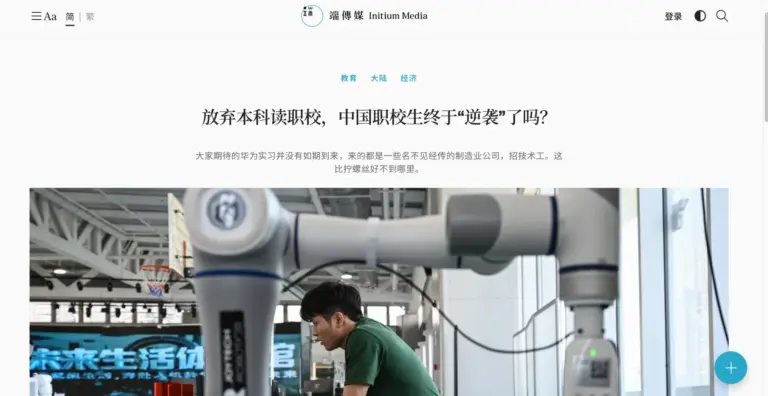
But in practice, Initium finds, the promise of future employment eventuating from this vocational push isn’t so clear. Even at Shenzhen Polytechnic University, a flagship vocational school which partners with Huawei and BYD, few students reach the companies advertised on the brochure. Most internships are at little-known factories – in one student’s eyes, no better than “tightening screws.” Some graduates drift into sales or bubble tea shops. Those without placements are sent to assembly lines, their internship stamps counted towards a near-99% employment rate. “They will threaten you with [withholding] your diploma,” says one graduate quoted in the piece.
Those who do land jobs at top companies find the hierarchy between vocational schools and regular universities follows them inside. One recruit at BYD shares that vocational hires start on the bottom grade, as electricians and fitters. Graduates of elite universities, even with unrelated degrees and no prior experience, can start two rungs higher.
A year in, Zhang has come to enjoy her hands-on logistics classes. She is collecting the certificates that might still earn her a bachelor’s degree (Chinese students who attend vocational schools are granted an “associate degree” or “higher education diploma” which is a tier lower than a bachelor’s degree. Beyond that, she doesn’t know what else to do but wait “for a new era or a new national policy.”
The world tends to picture Chinese students as high achievers on elite campuses, at home or abroad. Yet even Chinese graduates of top universities overseas, facing hard job markets where they studied, are now weighing a return home. And yet for them, as for Zhang, the question is no longer which path to take, but if the path leads anywhere at all.
Summary by journalist Eva Liu
| Eva’s take: Growing up in northern China, I spent my school years racing toward the gaokao, which we were told was our only chance to “change our destiny.” I even sat in the exam room twice to reach a university that felt right, and I wasn’t the only one. Later, while studying for my master’s in the U.S., I met Chinese students who had studied abroad far longer than I had; yet some are now weighing a return home for work, as staying gets harder each year. Among my peers, vocational college was never on the table; to many Chinese parents, it simply wasn’t worth the investment. Much of the reporting on vocational schools tells a story of rising status: a growing first choice, supplying nearly 10 million skilled workers a year. This Initium piece offers a reality check on what lies behind the policy: missing internships, padded employment figures, and a bubble of “hot” emerging majors that leads back to the factory floor. It also unsettles a picture many readers abroad hold of Chinese students as high achievers who never put down roots. Here are top scorers settling, not by choice but by necessity, and finding that even the compromise may not pay off. |
Original ‘放弃本科读职校,中国职校生终于“逆袭”了吗?’ first published in Chinese by Liang Yi for Initium Media on September 30, 2026.
*All interviewees’ names are pseudonyms.
Initium Media is a Chinese-language digital media outlet based in Singapore.