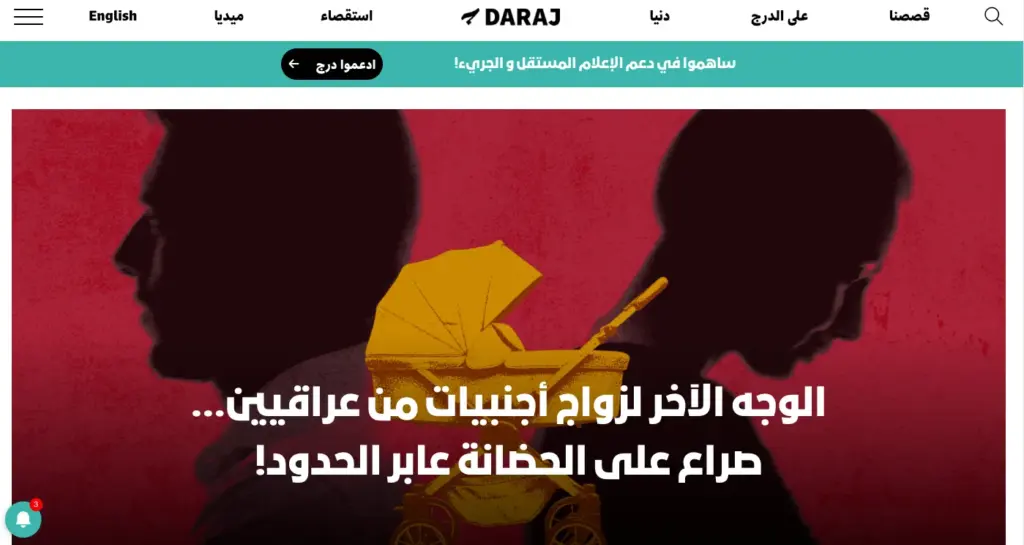
A Daraj Media investigation explores how residency rules, custody laws and legal loopholes can leave mothers separated from their children
When Ayla (not her real name) married an Iraqi student she met in Russia, she imagined a new life in Iraq. After the couple had two children, their marriage broke down. She returned to Russia with her younger son, while her older child remained in Iraq with his father, who cut ties with her. Years later, she is still trying to rebuild contact with the child she left behind.
Her story is one of several examined in an investigation by Daraj, which features interviews with women from Russia, Ukraine and Syria, alongside lawyers, officials and women’s rights advocates. The investigation shows how these mothers seeking recourse are systematically failed by immigration rules, family law and nationality legislation, with few mechanisms to protect their relationship with their children.
It also shows that many foreign wives arrive in Iraq with little understanding of the legal system they are entering. Lawyer Mohammed Jumaa explains that some women enter the country under their husband’s sponsorship, leaving them dependent on him even to leave Iraq. In practice, he says, women may struggle to pursue custody or maintenance claims because they lack independent residency, financial support or even a place to stay while court proceedings unfold.
Ayla describes repeated attempts to maintain contact with her son in Iraq, saying communication became more sporadic after her return to Russia. She says she received threats from her former husband and his relatives and faced accusations online that she had abandoned her child. Daraj contacted her former husband for comment but received no response before publication.
Olga is a Ukrainian woman who moved to Iraq after marrying an Iraqi medical student. She recounts how domestic abuse, family pressure and a dispute over her children’s custody eventually led to years of legal battles spanning multiple countries. Olga alleges that one of her sons was taken to Iraq without her consent and says she has spent years trying to regain contact with both children through lawyers in Ukraine, Denmark and Iraq. Her former husband also did not respond to Daraj’s requests for comment.
A third case centres on Gulnar, a Syrian woman who has lived in Iraq for more than a decade but says she remains caught between unresolved residency procedures, an ongoing marriage and fears of being separated permanently from her children.
Iraqi officials explain that children born to Iraqi fathers remain subject to Iraqi family law, and that mothers cannot automatically take them abroad even when they are granted custody. Women’s rights advocates argue that broader shortcomings, including the absence of dedicated domestic violence legislation and controversial provisions in Iraq’s Penal Code, leave many women with inadequate legal protection.
Rather than presenting these stories as isolated family disputes, Daraj exposes a wider gap in Iraq’s legal system. For foreign mothers, the end of a marriage can trigger a complex cross-border struggle in which questions of residency, nationality and custody become deeply intertwined, leaving many women fighting not just for financial compensation, but the right to see their children again.

The original article ‘الوجه الآخر لزواج أجنبيات من عراقيين… صراع على الحضانة عابر الحدود!’ was first published in Arabic by Ayoub Saad for Daraj on July 28, 2026.
Daraj is an independent media platform for women’s issues, minorities, the environment and climate change.
Summary by contributing editor Cendrella Azar
Cendrella’s take: Beyond sensationalized reporting on individual cases of child custody battles, this investigation helps readers understand the legal framework governing such disputes. By placing individual stories alongside legal analysis and official responses, it shows how these cases are not exceptional tragedies but rather symptoms of broader structural shortcomings that disproportionately affect women. It offers English-language readers a rare look at how family law, migration and women’s rights intersect in contemporary Iraq.