
How corporations, pension funds, and other financial actors are driving land dispossession in Brazil
Many people in cities across Europe and North America might be familiar with real estate speculation and private equity firms buying up their city’s housing stock with the expectation that it will appreciate over time. But this phenomenon – as journalist Bruna Bronoski writes in a recent article for O Joio e O Trigo – is just the tip of the iceberg in Brazil. Here, land has become a financial asset that can be purchased and traded away at will by faraway speculators – a trend that is driving land dispossession among vulnerable communities.
She begins her piece by explaining how “financialisation” works in the abstract: deregulation and globalisation in the 1970s and ‘80s have enabled corporations, investment funds, and private equity firms to accumulate huge pots of money that they have sought to put to work by buying land and real estate in places such as Brazil.
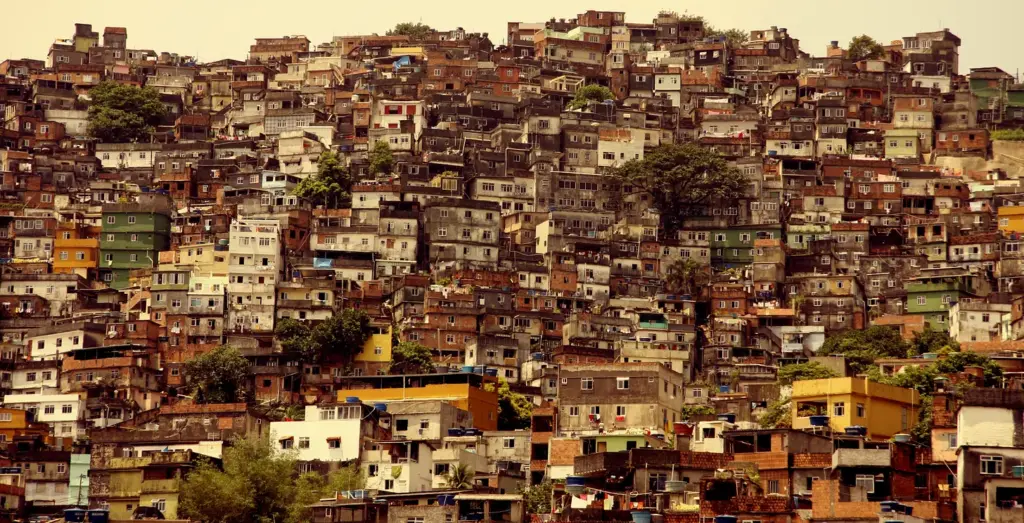
She cites experts in economic and agricultural policy who say communities are being forced from their land (the lifeblood of the community) and “pushed to rural backwaters – unproductive lands, environmentally degraded and far from their place of origin.” Others find themselves confined to “urban peripheries” like favelas that lack proper education, health and transport services.
Bronoski describes how this practice is justified by a capitalist logic, whereby land previously dedicated to subsistence farming is given to agribusiness and thus subsumed into the market economy. This often goes hand-in-hand with long-standing criminal practices such as acumulação por espoliação and grilagem, she writes.
The former refers to Marxist geographer and social theorist David Harvey’s idea of “accumulation by dispossession”, which, in the Brazilian context, often amounts to violent expropriation of land at the hands of local landowners and multinationals, as well as through land grabbing. The ladder refers to the old Brazilian practice of falsifying the land registry: putting forged documents into boxes full of crickets (grilos) that would gnaw away at the paper, giving them a more authentic, weathered appearance.
Land dispossession of this scale wouldn’t be possible without the help of successive Brazilian governments, which – despite recognising collective land rights of minorities including indigenous peoples and Afro-Brazilian quilombolas in the constitution – actively support land speculation and financialisation by fostering joint ventures between local firms and foreign corporations to accumulate more land. According to Raquel Rolnick, a professor of architecture and urbanism at the University of São Paulo, the solution is for the state to pursue policies that seek to “definancialise” land, such as land trusts where ownership is shared locally and collectively.
This is essential in ensuring land is no longer a tradeable asset and instead returns to being the foundation upon which different Brazilian communities can build their futures.
The original article ‘Como os fundos e as corporações expulsam pessoas na cidade e no campo’ was first published in Portuguese by Bruna Bronoski in O Joio e O Trigo on June 2, 2026.
O Joio e O Trigo is a Brazilian non-profit platform for investigative journalism that focuses on food, health, and power.
Summary by Bartolomeo Sala